Monday, August 5, 2019

DIVERSITY IN HORROR MATTERS, AND HERE’S WHY


When Jordan Peele said he wanted to exclusively make black stories, some people got angry; but let’s discuss why we actually need more diversity.


Saturday, March 30, 2019

Horror Noire: Blacks in American Horror Films from the 1890s to Present by Robin R. Means Coleman

To celebrate the release of the Horror Noire on Shudder last month, and the recent premiere of Jordan Peele's sophomore film Us, I decided to read Dr. Robin R. Means Coleman's book on which the documentary is based. I've already reviewed the documentary over at Morbidly Beautiful, so I won't rehash it too much here, but suffice it to say it's a MUST watch for any horror fan. With interviews from Black horror directors, writers, actors, and academics, it's wonderful to see so many Black voices all sharing their experiences and voicing their opinions on famous Black horror films. The only downside is the limitations of the medium, that is, the documentary just doesn't have the time to go into the full history of Black horror or discuss every Black horror movie. Which is why you should definitely read the book! Horror Noire: Blacks in American Horror Films from the 1890s to Present (or at least the aughts, when the book was published) gets to fully explore all the fun details that couldn't be included in the documentary, from the birth of zombie movies to the evolution of Black women in horror from eye candy to demon slayers.

Using Dr. Coleman's book as a basis, I've created a timeline of over thirty Black horror films that I feel best illustrate the evolution of Black representation in American horror films. For a more in-depth study into the topic (and a list of recommended viewing and reading), check out this great Horror Noire Syllabus created by Dr. Coleman, Tananarive Due, and the Graveyard Shift Sisters.

The Undertaker's Daughter (1915)The Lubin Manufacturing Company used Black actors in their horror comedy short, The Undertaker's Daughter. Prior to this, Black characters were almost exclusively played by White men in Blackface who portrayed them as lazy, foolish, and cowardly for comedic effect. These racist caricatures, commonly known by the dehumanizing slur "coon", were a mainstay in minstrel shows, and appeared in films produced and written by Whites for White audiences.


Birth of a Nation
Birth of a Nation (1915)In 1915 the White supremacist propaganda film Birth of a Nation was released with president Wilson's endorsement. This time Black men were not merely portrayed as lazy buffoons, but violent, lecherous creatures who preyed on White women, a dangerous stereotype that had already resulted in the murders of thousands of Black men and children. Lynching for "eye rape" would continue well into the 1950s [1]. The image of the predatory Black man popularized by Birth of a Nation would continue to appear as a horror film "monster" for decades to come as White men lived out film fantasies of violently protecting damsels in distress.

Shadowed by the Devil (1916) In response to the blatantly offensive depictions of African Americans in Birth of a Nation Black-owned film studios like the Lincoln Motion Picture Company and Frederick Douglass Film Company were founded to tell positive Black stories by and for Black people. Called "race films," these movies featured all Black casts portraying complex, realistic characters. One such race film, the now lost Shadowed by the Devil, is a frightening morality tale that focused on what it means to be a good person. Sadly, most of these studios would go under during the Great Depression.


Mercy, the Mummy Mumbled
Mercy, the Mummy Mumbled (1918)The Ebony Film Corporation, a White-owned company, attempted to cash in on Black audiences by producing their own "race films" which included five comedy horror shorts. Unfortunately, Ebony relied on tired, racist tropes for their humor which outraged Black viewers and prompted complaints in the Chicago Defender, a popular Black newspaper.

A Son of Satan (1924)Oscar Micheaux, founder of the Micheaux Film Corporation, was the first Black feature filmmaker in America. He made over forty films during his thirty-year career. His "fright films" more closely resembled "true" horror movies. Micheaux cleverly booked and advertised A Son of Satan without approval from the Virginia film board (who objected to scenes of Black men "carousing," murder, and the killing the leader of "a hooded organization," a thinly veiled allusion to the Klan), in order to avoid censorship of his movie and maximize profit.

Black Moon (1934)From 1915 to 1934 the US military forcibly occupied Haiti. White Marines ignorantly viewed the Haitian's religious practices as primitive and evil, and shared outlandish stories about human sacrifice, cannibalism, and raising the dead when they returned home. These fantastical accounts would inspire the "Voodoo" and jungle films of the 1930's where "savage natives" controlled zombies and threatened the virtue of beautiful White women.  In Black Moon, the White Juanita is so corrupted by Black culture that she goes insane and her husband is forced to kill her.


Chloe, Love is Calling You
Chloe, Love is Calling You (1934)In the Voodoo horror film Chloe, Love is Calling You the titular White-passing Chloe is cast as a tragic heroine because she's biracial. She's often threatened by the Black men who either want to rape or sacrifice her, and is so disgusted by her own alleged Blackness that she frequently flies into hysterics and throws herself into danger. The moment Chloe discovers she's actually White she abandons the Black "mammy" who raised her without a second thought. Even though the film does not shy away from discussing racial violence and lynchings, it still implies Whiteness as superior and condemns any Black people who desire revenge for the treatment they've received.

The Devil's Daughter (1939)"Jungle Films" portrayed Black Americans as more intelligent, sophisticated and "loyal" to Whites than Voodoo practicing Africans and Caribbeans. The Devil's Daughter, which was targeted towards Black audiences, pit the Jamaican daughter of a Voodooist against her Harlemite half-sister for control of their family plantation. The sister from Harlem is cosmopolitan and bourgeois, but gullible and out-of-touch with her roots, while the Jamaican sister is rough around the edges but more down-to-earth. In the end the two women come to a mutual understanding and respect.


Son of Ingagi
Son of Ingagi (1940)The original Ingagi was a racist exploitation film billed as an African documentary that implied that Congolese women bred with gorillas to produce monstrous hybrid offspring. African American actor Spencer Williams Jr. wanted to create a film with better representation for Black audiences so he wrote and starred in Son of Ingagi, the first science fiction horror film to feature an all-Black cast [2]. Unlike its "prequel," the gorilla in Williams' film was just a monster, not a metaphor, and the movie's Black stars were cast in more distinguished roles. Williams plays a detective, while actress Laura Bowman portrays Dr. Helen Jackson, a brilliant and wealthy researcher.

The Blood of Jesus (1941) -  In addition to writing and producing several race films, Spencer Williams Jr. also directed the religious morality horror movie The Blood of Jesus. In it, the pious Martha is tempted by a demon who shows her the excitement of Northern city life. She ultimately rejects the flashy clothing and jive in favor of her more modest and virtuous Southern lifestyle, thus saving her soul from damnation. The moral superiority of Southern Blacks compared to their "sinful" Northern cousins was a frequent theme in religious horror movies.


King of the Zombies
King of the Zombies (1941)As the popularity of horror films was waning, most likely due to the very real horrors of WWII, so too were opportunities for Black actors in film. Many found themselves choosing between playing a comedic coon archetype in roles reminiscent of Minstrel Shows or going without work. Mantan Moreland was one of many Black actors who made a successful career out of playing such characters in horror comedies like King of the Zombies, and he was frequently cast in central roles, receiving top billing next to his White costars. But his fame came at the cost of furthering harmful Black stereotypes.

Monster from Green Hell (1957)Xenophobia and Cold War fears shaped the horror films of the 1950s, which were filled with extraterrestrial invaders and science experiments gone wrong, but very few Black characters. Even though roles were scarce, Black actors like Joel Fluellen still advocated for better representation in film and TV. In Monster from Green Hell, Fluellen's character, Arobi, is an intelligent and well-spoken African man whom the White scientists respect and consult for advice. While the film is still deeply problematic Fluellen proved that Black actors could play important roles in horror movies without relying on tired, racist tropes.

The Leech Woman (1960)As hard as it was for Black actors to find work, it was even harder for Black actresses. It was especially rare for Black women to land a central role in a White film. In The Leech Woman, Estelle Henry plays Malla, a 152-year-old former slave whose people hold the secret to eternal youth and long life. Malla's character was still saddled with stereotypes, being African made her "exotic" and knowledgeable about magic, but she was also progressive in her own right. A smart, tough, fierce feminist, Malla protested the ageism shown to older women and convinced a sleazy White doctor to pay for her trip back to her homeland.


Night of the Living Dead
Night of the Living Dead (1968)The same year the Civil Rights Act was signed into law, George Romero released his revolutionary zombie film, Night of the Living Dead. The low-budget flick starred African-American actor Duane Jones as its protagonist Ben, the very first Black lead in a horror film not targeted solely to Black audiences. Ben was no frightened Stepin Fetchit or voodoo priest, but a charismatic and confident survivor whose quick thinking and coolness under pressure keep him alive until the end of the film. Equally remarkable, the zombies Ben fights aren't the result of Voodoo or African magic, but were instead reanimated by space radiation. When Ben finally does meet his demise, it's at the hands of a White (living) mob, an all too familiar image for Black audiences, especially during the 1960s. The film was a box office success, largely due to its popularity with Black moviegoers.[3] This would lead to a series of sequels, which also featured Black characters in important roles.


Blacula
Blacula (1972)During the 70's a sub-genre of the exploitation film emerged called Blaxploitation. These movies, often created by White writers and directors for Black audiences, drew inspiration from Black power ideologies and frequently centered around overcoming White oppressors.  Unfortunately, the genre was also deeply homophobic, exploitative of women, and condemned by many Black organizations for its use of criminal stereotypes. Blacula was the first, and most famous blaxploitation horror film, about an erudite African prince who is transformed into a vampire and ironically begins to prey on Black communities. The film's success lead its production company, AIP, to continue creating Black horror films.


Ganja and Hess (1973)The art house film Ganja and Hess starred Duane Jones –of Night of the Living Dead fame -- as Dr. Hess Green, a wealthy archaeologist. Dr. Green's sophistication and elegance made him the polar opposite of the hypermasculine, violent men in Blaxploitation films who earned their money through illegal means. Despite winning the critic's choice prize at the Cannes film festival, Ganja and Hess' producers were unhappy with the movie and suppressed it. They had wanted something similar to Blacula, and weren't sure what to do with a vampire story about addiction that lacked the Blaxploitation tropes with which audiences were familiar.


Scream, Blacula, Scream
Scream, Blacula, Scream (1973) -  While White "final girls" were portrayed as virginal and pure, Black heroines were hypersexualized for a straight, male audience. So it was unusual when Pam Grier, who was frequently cast as a seductive sex idol in other Blaxploitation films like Foxy Brown and Coffy, got to play a conservatively dressed heroine named Lisa in Scream, Blacula, Scream. Lisa is elected leader of her Voodoo group, and uses her skills to try and free Blacula from the curse placed on him by the White Dracula. She is also a protector who saves her boyfriend from the angry vampire.

Abby (1974)Abby is a low-budget Exorcist knock-off that was, as the New York Times put it, "more silly than shocking" and never quite reached the levels of cult classic that Blacula did. The titular Abby, a pious minister's wife, becomes possessed by a being claiming to be the Yoruba Orisha, Eshu. Unlike Pazuzu from The Exorcist, Eshu seems more interested in sex and swearing than destruction, which leads to some very silly scenes. Even though the being possessing is supposedly Yoruba in origin, African religious beliefs are never condemned or portrayed as evil, and the film makers clearly put effort into their research. Eventually, the heroes use a combination of Christian and Yoruba beliefs to free Abby.


Sugar Hill
Sugar Hill (1974)Diana "Sugar" Hill is the perfect example of the regressive treatment Black women often received in Blaxploitation films. After the murder of her boyfriend at the hands of a "Whitey" crime boss, Sugar is desperate for revenge, but unable to seek it without help. She makes a deal with Baron Samedi, the Vodou loa (god) of death and sex, offering herself in exchange for the murders of those responsible for "killing her man." Sporting tight, revealing outfits, Sugar seduces and tempts her victims before Samedi's zombies kill them off, wielding her sexuality like a weapon. She also spends most of the film flirting with her ex-boyfriend implying Sugar cannot be without a man.

The Shining (1980)By the eighties, blaxploitation had fallen out of favor, and when Black actors did appear in film, they were surrounded by Whites and White culture, and paired up with White actors in "buddy films". Horror films were no exception, and Black characters were reduced to sacrifices so their White friends could survive. An example of this is Dick Halloran, played by Scatman Crothers, in Stanley Kubrick's The Shining who is pointlessly killed while attempting to aid the film's White family. Even worse, Dick is also a "Magical Negro" a wise Black man with magical powers who exists only to help the White characters with their problems. Magical negroes arose from a misguided attempt by White writers and filmmakers to counter traditional racist tropes. Unfortunately, all this did is create new stereotypes.


The Thing
The Thing (1982)In John Carpenter's The Thing, Keith David's character, Childs, shares many similarities to Ben from Night of the Living Dead. Instead of being a "scared negro" or self-sacrificing Black, both characters are distrustful, resourceful hot-heads who question the authority of the White men they're trapped with and live to the end of the film. But while Ben has only just met his fellow zombie survivors and has no reason to trust them, Childs has presumably worked alongside and lived with his colleagues for months, yet is still cold to them. The hostility amongst the group could be explained by both racial and class tension. By the end of the film, Childs and Kurt Russell's character, MacReady, are presumably the only two survivors and now on equal footing.

The Serpent and the Rainbow (1988)Although The Serpent and the Rainbow does have a more accurate representation of Vodou than most movies (at least the ones not targeted to Black audiences), its portrayal of Haitians is hardly a step up from the jungle films of the 30s. Despite taking place in Haiti and centering around a Black religion, the protagonist is a White man named Dennis who plans to take "zombie powder" back to the States for a pharmaceutical company. Dennis is perfectly willing to appropriate a cultural practice for profit, which he has no intention of sharing with the Haitians who aid him, yet he's still cast as a hero. Throughout the film "evil" Haitians use Vodou to harass and threaten Dennis in an attempt to make him return home without the drug. 
People Under the Stairs

The People Under the Stairs (1991)In the eighties, urban areas were portrayed as violent, drug stricken, impoverished, and largely inhabited by Black Americans, which led to White flight to wealthy suburbs and a new form of segregation. In Wes Craven's The People Under the Stairs, a Black child from the ghetto becomes trapped in a suburban mansion belonging to a pair of serial killer slum lords. The incestuous couple, known only as Mom and Dad, are able to conceal their crimes and depravity because they are wealthy and White. Even when police are called to investigate the couple's home, they perform only a precursory search and leave without suspicion, never noticing the basement full of dead bodies and kidnapped, tortured children.

Candyman (1992)Clive Barker's Candyman film was another movie that exploited fears of the inner city, combined with the threat of a supernatural killer like Freddy Krueger and Jason Voorhees. The Candyman, played by Tony Todd, was the vengeful spirit of a Black artist from the late 1800s who was tortured and lynched after falling in love with a White woman. Strangely, he chooses to prey on a poor, Black community rather than seek revenge on wealthy Whites like the ones who killed him. Unlike other Black monsters, Candyman was suave, sophisticated, and even sympathetic, but he still played on fears of the Black Boogeyman by lusting after the White female protagonist. Equally problematic, the White woman gets to be the film's hero, saving the poor, Black characters who literally turn to her as a saint and savior.


Tales from the Hood
Tales from the Hood (1995)While the name of the anthology brings to mind the campy and often humorous TV series Tales from the CryptTales from the Hood is actually a sobering, social commentary in the same vein as other morality horror films about retribution. In a subversion of the Voodoo films from the thirties, zombies and Vodou are used as protection against the real monsters, racist politicians, corrupt cops, violent gangs, and abusers. While the movie does contain plenty of strange creatures and cheesy special effects, it's the real-world imagery that's truly frightening; a Black man getting violently beaten and murdered by cops while Billy Holiday's Strange Fruit plays hauntingly in the background, flashes of grainy photos showing lynchings, or a child cowering as his mother is beaten bloody by her boyfriend.

Beloved (1998) Based on the Pulitzer prize book of the same name and boasting an all-star Black cast including Oprah Winfrey and Danny Glover, the Southern Gothic film Beloved was praised by critics and audiences alike, a rare feat for a horror film. Instead of relying on zombies or supernatural killers for cheap thrills, the movie's terror came from its uncompromising depiction of slavery and the painful legacy it leaves. Previously, Voodoo films had simply glossed over the cruelty that had brought Blacks to America and the Caribbean, preferring to further a colonial fantasy of Whites "civilizing" Africans.

Bones (2001)Rap music has long been influenced by, and paid tribute to, horror from Will Smith's family friendly Nightmare on My Street in 1988 to the successful horrocore hip hop band Geto Boys in the 90's. Rappers, like Ice-T and Coolio, even began acting in horror films.[4] So it should come as no surprise that the music genre would eventually inspire horror. One of the few hip-hop horror movies to have a theatrical release was Snoop Dogg's Bones, directed by Ernest Dickerson of Juice fame. The movie was an homage to Blaxploitation films, and boasted Pam Grier as the love interest of Snoop's "gentleman pimp" character, Jimmy Bones.
Alien vs Predator

Alien vs Predator (2004)Black women were beginning to appear more frequently in horror films, and not just as the Seventies sex pots or victims, but as surviving women who fought monsters. In Tales from the Crypt: Demon Knight, another Ernest Dickerson movie, Jada Pinkett defied audience expectations by not only surviving but becoming the movie's heroine despite pressure from the studio to cast a white actress as the "final girl." In the first crossover film of the Alien and Predator franchises Lex, played by Sanaa Lathan, is not only a "final girl," surviving attacks from both alien species, but a bad-ass action heroine. Lex becomes the first human in the Predator films to earn the honor of being marked as a warrior by a Predator after she helps him to kill three Xenomorphs, something not even Schwarzenegger could accomplish.

Bloodz vs Wolvez (2006)The aughts would see the release of dozens of low-budget, direct-to-DVD hip hop horror movies. The films were aimed at younger audiences and often used postmodern spelling like Vampz or Cryptz.  In one such movie, Bloodz v. Wolvez a vampire king named Asiman is attempting to broker a peace between two rival gangs, the working class werewolves (Wolvez) and the wealthy vampires (Bloodz). The sophisticated vampires look down on the Wolvez while also envying their ability to walk in the daylight, while the werewolves view the Bloodz with contempt for assimilating with humanity and acting superior. But even with the all the wealth and power Asiman has acquired since escaping slavery centuries ago, he is still seen as "lesser" by Whites, as is highlighted when a White patron of the vampire king's club asks him to caddy for him in a golf game.


Attack the Block
Attack the Block (2011)At first glance it appears that John Boyega's character in Attack the Block, Moses, will be a threatening "Black boogeyman" type character after he robs a White woman, or perhaps a Blaxploitation-style glamorized criminal. Instead, Moses is a complex, flawed character who cares deeply about his "block," is protective of his friends, and struggles with his anger and impulsiveness. A Black girl rightfully calls Moses out for robbing an unarmed woman, but also confronts his victim about her privilege and calling the police on Black teenagers. The two end up cooperating to defeat an alien attack that threatens their impoverished neighborhood.

The Girl with all the Gifts (2016)The film takes place in a near-future dystopia where humans have been driven underground by a pathogenic fungus that turns people into zombies called "Hungries." A group of hybrid children, who crave living flesh like the Hungries but retain their human intelligence and emotions, are being used to create a cure. While Melanie, an especially intelligent and gifted hybrid child is initially happy to cooperate with the soldiers and scientists who hold her captive, she refuses to let herself be killed to develop a cure. While the older generation sees the hybrid children as monsters to be cured or controlled, Melanie realizes that she and the others are merely a new species, who have just as much right to live and thrive as humans. Like with Night of the Living Dead, the role of Melanie in The Girl with all the Gifts was not specifically written for a Black actor, it just so happened that Sennia Nanua had the best audition, but by casting a Black lead the film gained added social commentary.


Get Out
Get Out (2017)Jordan Peele became the first Black person to win an Academy Award for Best Original Screenplay with his groundbreaking Black horror film, Get Out. Rich with imagery, the movie centers around racism in America and Black fears, making subtle references to past and present atrocities such as slave auctions, medical experimentation on Black people, and police brutality. It also turns the "Black buck" trope on its head. The protagonist, Chris, is never portrayed as sexually aggressive. Instead, it's the sociopathic White woman who preys upon Black men by seducing them and hunts Chris down with a shotgun. This inversion of horror movie cliches is further underlined by the dead deer (aka Bucks) displayed around the White family's luxuriant home. The film also introduced audiences to "The Sunken Place," a literal pit of despair that leaves its victims trapped, silenced, and powerless, the perfect metaphor for the feeling of helplessness Black people experience living in a world where they're constantly oppressed and surrounded by racism[5].

The First Purge (2018)The Purge franchise is about a near-future totalitarian America where once a year all crime, including murder, is legal for a 12-hour period. The First Purge, the prequel to the series, focuses on the initial experiment which eventually leads to a Nationwide Purge. With echoes of the Tuskegee syphilis experiment, the detached, white scientists purposely target low income minorities for their unethical study. When the White men running the political party funding the purge sees that the Staten Island residents aren't killing each other like they'd hoped, they send in masked mercenaries dressed as Klansmen and Nazis to slaughter the poor to make their experiment seem successful. They even enter a Black church to slaughter everyone seeking shelter inside.
Us

Us (2019)Jordan Peele's sophomore film was another critical and commercial success for the director, proving once again that Black stories can be just as loved and popular as White ones. Peele not only produced another unique horror film, but demonstrated that Black horror isn't limited to racial commentary. Black history and Black horror are inextricably linked, and many popular Black horror films like Get Out, Beloved, Tales from the Hood, etc. draw on the very real horrors of White supremacy to elicit terror from their audiences. In many ways, Black horror is a form of catharsis, vividly depicting Black pain but also showing its heroes fighting back and even defeating more tangible monsters. But limiting Black stories to tales of American racism and oppression can also be problematic. Us is still very much a Black narrative, steeped in Black culture, but without Whiteness defining the characters or story.

All the films on this list are available to own, rent and/or watch online with the exception of The Undertaker's DaughterShadowed by the Devil, and A Son of Satan which are, sadly, lost films. Mercy, the Mummy Mumbled can be viewed on YouTube, but is badly degraded.

References
1. https://www.pbs.org/wgbh/americanexperience/features/emmett-lynching-america/
2. https://www.allmovie.com/movie/son-of-ingagi-v45617/review
3. https://www.jstor.org/stable/1225699?seq=1#page_scan_tab_contents
4. http://www.blackhorrormovies.com/rappers/
5. https://www.huffingtonpost.com/entry/get-out-what-black-america-knows-about-the-sunken_us_58c199f8e4b0c3276fb7824a

Wednesday, August 1, 2018

The Mine by Arnab Ray

The Mine by Arnab Ray. Recommended. Read if you like Event Horizon, Sex and Violence.


Formats: Print, digital

Publisher: Westland (Indian publisher now owned by Amazon)

Genre: Blood & Guts (Gorn), Psychological Horror, Occult
Audience: Adult/Mature

Diversity: South Asian/Desi/Indian, Disabled character (uses a wheelchair due to partial paralysis, mute/Aphonia)

Takes Place in: Thar Desert, Rajasthan, India

Content Warnings: Abelism, Bullying, Cannibalism, Child Abuse, Child Death, Child Endangerment, Death, Drug Use/Abuse, Forced Captivity, Illness, Gaslighting, Gore, Kidnapping, Medical Torture/Abuse, Medical Procedures, Mental Illness, Self-Harm, Rape/Sexual Assault, Sexism, Slurs, Slut-Shaming, Stalking, Suicide, Torture, Violence, Xenophobia (Highlight to view)

Blurb:
At a secret mining facility somewhere in the deserts of Rajasthan, an ancient place of worship, with disturbing carvings on its dome, is discovered buried deep inside the earth. Soon the miners find themselves in the grip of terrifying waking nightmares. One tries to mutilate himself. Worse follows.

Five experts are called in to investigate these strange occurrences. Sucked into a nightmare deep underground, they embark on a perilous journey; a journey that will change them forever, bringing them face-to-face with the most shattering truth of them all…

The greatest evil lies deep inside.


Imagine combining Event Horizon with Agatha Christie's And Then There Were None then mixing in the criminally underrated film Below. Set it in a mine deep below the Great Indian Desert and you'll get an idea of what you're in for in Arnab Ray's horrifying, claustrophobic, sex-filled gore-fest of a novel about five adults and one little girl trapped underground with their guilt.
The Mine starts out with Samar, a rich recluse specializing in industrial security, wallowing in his grief after the disappearance of his daughter and the death of his wife. Yeah, Samar has shit luck. A mysterious man named Arnold Paul (whose name I kept reading as Arnold Palmer) finally bribes convinces Samar to drag his depressed butt out of bed by offering him a large sum of money to go with him and do a sketchy job, the details of which Paul/Palmer won't reveal. Samar is apparently used to this sort of thing due to his work as a security expert/spy for secret government ops, and figures he wasn't doing anything important anyway (except moping and sleeping) so he begrudgingly accepts the offer and heads off for the titular mine. As it turns out, greed is a great motivator because Mr. Paul/Palmer has also convinced four other experts to go to the middle of nowhere with a complete stranger, no questions asked.

Joining Samar are Dr. Karan Singh Rathore, a diplomatic and laid back older gentleman who specializes in infectious diseases; Dr. Anjali Menon, a widowed archeologist who brought her disabled daughter, Anya, along; Dr. Akshay More, an arrogant and obnoxious assistant professor in forensic toxicology; and Dr. Preeti Singh, a short-tempered psychologist with a surprising lack of people skills. The group has been brought together to give their expert opinion on a series of deadly accidents that seem to have been caused by the discovery of an ancient, creepy temple the miners are too afraid to go near. A temple that also happens to be covered in explicit carvings of naked women being tortured and killed, because whomever created the damn thing is sexist and gross. If that wasn't ominous enough, the director of the mine is named Lilith Adams. While it's fully possible her parents were just uncreative goths from the early 00's, it's far more likely that Ms. Adams just picked the most obvious evil pseudonym since Alucard and Lou C. Pher.

At this point, most people would've noped the fuck out of there, but Samar and the scientists have clearly never seen a horror movie in their lives and are too wrapped up in their own issues to notice the whole situation has more red flags than a May Day parade in Moscow. The mine could not be more obviously evil if it had "Gateway to Hell" in big florescent lights over the entrance, ominous music playing in the background, and a bunch of demons chilling in the conference room. Then again, these are people who willingly followed a creepy stranger into the middle of nowhere to visit his sketchy underground dungeon (literally, the workers are all criminals and aren't allowed to leave until their contracts are up) because Paul/Palmer promised them candy/money. Little kids have more street smarts than this group, so I shouldn't be surprised they're completely oblivious to danger.

I mean, even I figured out the candy van was a trap after the first 9 or 10 times.
Akshay and Anjali explore the torture-porn temple and discover it depicts ironic punishments attributed to specific sins. Meanwhile, Karan and Preeti talk to the survivors, who share stories that would make Rob Zombie squeamish. Akshay makes light of the situation and acts like a jackass, Anjali does her best to ignore everyone and just do her job, Karan remains calm and reasonable, and Preeti is hostile and short-tempered. Samar checks the security and continues to have no fucks to give beyond a kind of creepy obsession with Anya, who reminds him of his dead daughter. The general consensus among the workers is that they've somehow opened a portal to hell and everyone in the mine is going to die horribly as a result of their dark pasts. Needless to say, company morale isn't great. At this point, everyone finally agrees this place is super creepy and they want to collect their paychecks and GTFO. Alas, in a twist that should come as a surprise to exactly no one, Lilith turns out to be evil, and sets off an explosion that kills all the mine workers and traps the six survivors (Samar, the scientists, and Anjali's daughter) inside while she laughs manically about the mine's real resource being fear. Worst. Job. Ever.
                                                                    Her name is Lilith, what did you guys expect?
The explosions cause the security systems to engage, sealing the group inside with a series of death traps. Because why wouldn't you want death traps in an already dangerous mine? On top of everything, an experimental gas that causes super human strength and insanity is being pumped through the A/C, which frankly, feels like overkill to me, but hey, they can run their portal to hell however they want. After their initial panic, presumably followed by the realization that they really should have seen all of this coming, the survivors formulate a plan to navigate the traps and make it to the surface. They're slightly hindered by the fact they have to trust each other and work together to make it out, and most of them are deceitful, suspicious, assholes, not to mention all the stupid puzzle traps that were apparently inspired by 80s video games. One such puzzle involves trying to obtain acid vials while avoiding motion activated laser and an electrified floor, and if you succeed you'll be rewarded with a chainsaw, which may be useful later. Unfortunately in this "game" their are no save points or extra lives.

What follows is about what you'd expect for a book about trying to escape from a possibly haunted mine with a bunch of jerks, but the predictability doesn't make the story any less suspenseful or gripping. But face it, if you're reading this book, you're looking for creative deaths, not creative storytellin, and boy, does Ray deliver there. Besides, the true mystery doesn't lie in their Aeneas-like journey through the mine, but in each character's backstory, all of which are slowly revealed as they try to escape the subterranean deathtrap. Each of the adults has done something criminal and escaped punishment, and have been struggling with their guilt ever since. The quality of the backstories varies, with some characters (like Akshay and Preeti) getting plenty of focus, while Anjali gets very little characterization beyond "the aloof mom". So too do their sins seem to be of differing severity. Some of the survivors have committed crimes so awful as to make them irredeemable, while others are more sympathetic and their sins, while still terrible, are still at least partly understandable. This disparity seems a little unfair as it means at least some of the group will potentially suffer a gruesome death (at least according to the carvings in the temple) over something that would normally earn them less than 15 years in prison (at least in the US, not sure about the Indian judicial system). It's not that their crimes aren't bad, they just don't seem to merit a sentence of being reduced to a puddle of bloody viscera.

We never really learn if the mine is truly being controlled by a demonic entity or if the group's guilt and paranoia (fueled by the hallucinogenic gas) is causing them to attribute bad luck to malicious forces and see things that aren't there. Samar even suggests that the whole thing is an unethical experiment by the government to test their new gas on subjects no one will miss, as there are far too many coincidences for mere random chance, and the temple may be a fake created to amp up their fear levels. Since none of the characters are able to trust their own senses, making them unreliable narrators, arguments could be made for either scenario, making the story even more spooky and disturbing. Monsters are scary, but they're even scarier when you can't even tell if they're real or simply the imaginary scapegoats of guilt-ridden, paranoid people. Even more frightening, Ray argues, are the depths of human cruelty and depravity, which are explored in each character's backstory. Though that may just be an excuse to squeeze more gore out of the story.

The Mine does an excellent job balancing itself between psychological horror and splatterpunk. The true scares lie in the book's creepy atmosphere, suspense, and the characters slowly succumbing to madness; the over-the-top gore is simply dessert. Unfortunately, this otherwise perfect blend of horror comes with as huge helping of misogyny. Yuck. Look, I'm fully willing to admit I'm part of the lowest common denominator who just wants to see heads exploding like overripe cherries and attractive people boning, but that doesn't mean I like sexism. Unfortunately, more often than not, the three seem to go hand in hand, much to the frustration of female horror fans, and other, more enlightened individuals who just happen to like hot sex and lots of blood. Ray isn't as bad some other authors out there, the violence is pretty evenly split between the genders and there aren't any scenes of knife-wielding killers chasing half naked women. He even manages to handle the subject of sexual assault fairly well, choosing to focus more on the problematic culture of victim-blaming and men who feel entitled to women's bodies rather than the rape itself. But he struggles with creating believable female characters, defining them by their relationships with men, and them victimizing them. Both of the female scientists have backstories that involve abuse and mistreatment at the hands of men, and instead of being written as strong, survivors, they both come off as bitter, man-haters. Apparently Ray subscribes to the theory that in order to be "strong" a woman must act rude, aloof, aggressive, and despise an entire gender, with the exception of that one special man who tames her with his magical penis. Which is why both Anjali and Pretti act like complete jerks, with Pretti especially flying off the handle at every perceived slight (she must be a great psychologist), and basically being awful to everyone except, ironically, Akshay whom she latches onto almost immediately (despite the fact that he's literally just the worst). Despite all her bluster, Pretti still falls quickly into the role of helpless victim in need of a man's protection at the first sign of danger. It's really embarrassing. I guess she can't help it because she's an emotional female with a hysterical uterus or some such nonsense. The women in the story are all described as being gorgeous, but only one male character is described as being very attractive, the wholly unlikable Akshay, and that's only because his appearance is supposed to reinforce how vain and materialistic he is. Many of the women are also incredibly horny, even minor characters, like Tanya the gold-digging nurse, and Ray paradoxically has no problem slut-shaming them for it (apparently enjoying sex is sinful enough to get you murdered by the mine), even though he later demonizes other characters for doing the same thing. Maybe the mine is just super slut shame-y. The unearthed temple certainly implies that someone behind the scenes hates women.

The women in the story seem less like real people and more like a weird combination of straw-feminists and male masturbatory material, with Ray putting way too much emphasis on their appearance, sex drives, and relationships with men. Then of course we have Anya, who, while thankfully not a sex object, is still treated as an object nonetheless. She barely gets any characterization, and doesn't communicate even through sign language or writing, she's just a blank slate for Samar to project his weird daughter obsession onto. It's doubly problematic since Samar seems to use Anya's disability as an excuse to treat her like a life-sized doll he can love, protect, and turn into his replacement daughter. Because she's mute he assumes she has nothing to say, and because she doesn't walk he thinks she's completely helpless. We don't even get to learn what she's thinking, or how she feels about Samar treating her as some sort of second chance, because, unlike the other characters who all get their turn in the spotlight of the limited, third-person narrative, Anya is completely ignored. At least she gets a little bit of a role later on (which I won't spoil). Miraculously, Lilith Adams is the only female character who is neither a victim, nor a sex fantasy, and is described only as being terrifying, intense, and very much in charge, much like her namesake.

This definitely feels like a stranger danger situation.
So the female characters are about as well written as you'd expect from a male author who doesn't know how women work, and the whole "helpless, sick wheelchair girl" trope is super problematic. It's not the worst treatment of women I've seen in splatterpunk, but I'd still prefer to enjoy my blood and guts without the side of sexism. I mean, I don't think it's an unreasonable request. The writing is still pretty good, and it's definitely the scariest book I've read so far this year. The Mine is also one of only a few Indian horror novels I've been able to find in English. Whether that's enough to overshadow the book's problem areas, however, is up to the individual reader. 

Thursday, June 21, 2018

My Sweet Audrina by V.C. Andrews


Writing - 4, Horror - 3, Diversity - 2


Formats: Print, audio, digital

Publisher: Link to book

Genre: Gothic Horror, Romance, Thriller
Audience: Adult/Mature

Diversity: Intellectual Disability, Possible Autism, Physical Disability (bilateral above the knee amputee), Chronic Illness (Osteogenesis imperfecta/brittle bone disease), PTSD

Cognitive/Learning Disability

Takes Place in: Southern US

Content Warnings: Abelism, Alcohol Abuse, Body Shaming, Bullying, Implied Cannibalism, Child Abuse, Child Death, Childbirth, Death, Forced Captivity, Gaslighting,  Illness, Emotional Incest, Medical Torture/Abuse, Miscarriage, Mental Illness, Pedophilia, Physical Abuse, Racism, Rape/Sexual Assault, Implied Self-Harm, Sexism, Sexual Abuse, Slut Shaming, Suicide Attempt, Transphobia, Verbal/Emotional Abuse (Highlight to view)


Blurb:

V.C. Andrews, author of the phenomenally successful Dollanganger series, has created a fascinating new cast of characters in this haunting story of love and deceit, innocence and betrayal, and the suffocating power of parental love.
Audrina Adare wanted so to be as good as her sister. She knew her father could not love her as he loved her sister. Her sister was so special, so perfect -- and dead.
Now she will come face to face with the dangerous, terrifying secret that everyone knows. Everyone except...
My Sweet Audrina

Holy fuck, this book.


I’m curled up, holding my knees to my chest, and looking shell shocked. My right eye is twitching. “WTF” I ask as I stare into the void.
This book is definitely the winner of the OMGWTFBBQ award

If you're unfamiliar with V. C. Andrews, she wrote gothic horror novels during the eighties about really messed up, toxic, abusive, families that Lifetime loves to turn into terrible made-for-TV movies.  A standard Andrews book usually contains gas lighting, emotional and physical abuse, dark family secrets, and some of the most fucked up relationships ever put to paper that run the gambit from pedophilia to incest. Imagine if all guests on the Jerry Springer show were rich, beautiful, gothic heroines with enough skeletons in their closets to start their own ossuary, and you'll have an idea of what you're in for. They're trash novels, but in the best possible way, written by a talented author who knows her audience is looking to be shocked and horrified, like splatterpunk without the gore. Her stories may be ridiculous and over-the-top at times, but never, ever dull, and of all her fucked up books, My Sweet Audrina is probably her most fucked up. It manages to contain nearly every content warning I have that doesn't involve blood and gore (although there is a rather grisly scene where a woman miscarries and throws one of the blood clots at her mother in a fit of rage). There's a brutal child rape, a lot of abuse by a manipulative bastard, everyone messing with Audrina's mind, and a dead aunt who may or may not have been eaten by cannibals, so be forewarned, My Sweet Audrina is not for the squeamish.

Damian Adere, the family patriarch, is aptly named because the guy is just fucking evil. He's greedy, immature, vain, sexist, lazy, abusive, controlling, narcissistic, and manages to destroy the lives of every woman he knows while still seeing himself  as the victim because he's just that fucking self-centered. Yet, he continues to get away with his awful behavior because he's handsome, charming, and extremely manipulative, which honestly makes him even more frightening. In the first few chapters he comes off as kind of a dick but still likable. His daughter, Audrina, who acts as the book's narrator, still loves and respects him. But over the course of the story as we witness his true nature, Damian quickly goes from seemingly well-intentioned but misguided, to a full-blown asshole, then finally becomes Satan incarnate. In fact, I'm still not entirely convinced this isn't some sort of sequel to The Omen where the Anti-Christ kid grows up to become a lazy, whiny, codependent, narcissistic asshat who gets married and lives in a dilapidated mansion that he never lets his daughter leave. Actually, comparing Damian to Satan seems unfair because even the Dark Lord isn't that big of a flaming dick. I can just imagine the devil reading My Sweet Audrina and being utterly horrified. The other characters, save for our virtuous heroine, Audrina, aren't a whole lot better, although a lot of their behavior can be more or less attributed to Damian's abuse.
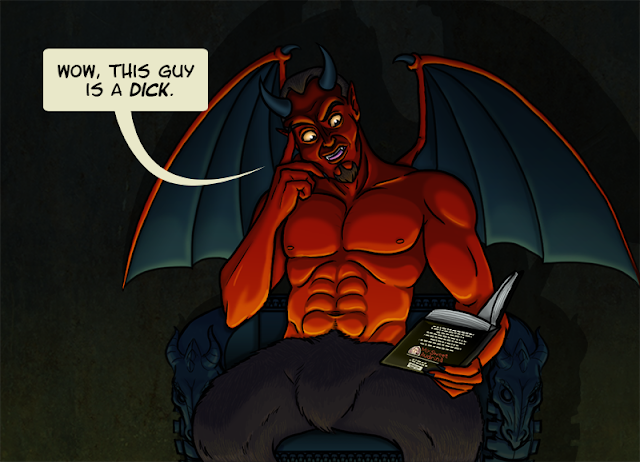
Satan is leaning back in his creepy dragon chair reading “My Sweet Audrina”. He has red skin, black horns, bat wings, furry goat legs, a goatee, and well-defined abs. The image is dark, and lit from below. Satan has a finger to his temple and comments “Wow, this guy is a DICK” (referring to Damian).
I just assume Satan is ripped
Audrina's mother, Lucietta, had to give up her dream of becoming a concert pianist to marry Damian (because he didn't want his wife to make more money than him), and now hides her misery by living in denial and drinking to numb the pain. She frequently lashes out at her sister, Ellsbeth, who has become bitter (again, thanks to Damian) and abusive, neglecting her own daughter, Vera. In turn, Vera has turned into a complete monster before the start of the book because nobody loves her and Damian (whom she sees as her father) constantly treats her like shit and compares her to his "perfect" daughter, Audrina. As horrible as Vera is (and she's pretty fucking horrible), you can't help but feel sorry for her. She's forced to be the whore to Audrina's virgin, which makes her hate and resents her cousin. She's so desperate for love and attention that 14-year-old Vera has "sex" with an adult man (everyone acts like it's consensual sex when it's very clearly statutory rape), and acts seductively from a young age. Of course none of the adults think "Hey, this isn't normal behavior for a child, maybe we should get her some help" they just decided "She's just a slut, oh well, who cares." Meanwhile Audrina is haunted by memories of a childhood rape, which her father keeps forcing her to remember in a sick attempt to make her "perfect" (I'm not even going to try and explain Damian's troll logic on this one). He reinforces her role as the virgin by frequently telling his daughter that all men are evil and forcing her to cover up in old fashioned dresses lest she be attacked. Is it any wonder Audrina becomes terrified of sex and disgusted by nudity to the point that she can't even be intimate with someone she loves without trauma? Of course Damian is totally fine with this because it means she's less likely to have a relationship with any man that isn't him. If that makes your skin crawl, well, it should, because even Audrina describes their relationship as being like husband and wife without the sex. Ew. At least there isn't any actual incest like I was fearing, which is a first for a V C Andrews novel. 

Even Lucietta isn't safe from her husband's slut shaming, as Damian flies into a rage if her outfits are too revealing and accuses her of flirting with the men at the parties he forces her to host. He wants to show off his pretty wife, but then gets ridiculously jealous when other men think she's pretty and ends up throwing a tantrum. He loves to be surrounded by women who adore him, but doesn't want to share, so everyone is essentially trapped in this giant, run down house where Damian can keep an eye on them, isolated from the rest of the world. Like I said, the dude is fucking evil, and doesn't even realize it. Or maybe he does, but simply doesn't give a shit. Basically, if there was a drinking game where you had to take a shot every time Damien pulls a dick move, no one would ever finish the book because they'd die from alcohol poisoning after a few chapters.

Now, you're probably wondering where the diversity comes in. I chose this book because of its representation of disability which, while not ideal (especially in Sylvia's case), was at least written by an author who herself had a physical disability for most of her life. As a teenager, Andrews developed severe arthritis and underwent multiple spinal surgeries to treat it. Andrews says this was the result of a back injury she sustained from falling on a staircase in high school, while her family claims it was something she was born with. Regardless, the resulting chronic pain required the use of a wheelchair or crutches for most of her life. Andrews lived at home, under the care of her mother, where she completed a four-year correspondence course in art, before starting her career as a writer. Her very first book, Flowers in the Attic, is about four children who are kept in the attic for years by their religious grandmother, and the toll it takes on their mental and physical well-being. Andrews said in a 1985 interview for Faces of Fear that Flowers in the Attic was based on her own feelings of frustration at being trapped at home. While accessibility for people with mobility issues still isn't great, I can imagine it was even worse when Andrews was growing up, and she died four years prior to the passing of the Americans with Disabilities Act. This theme of feeling "trapped" continues in My Sweet Audrina, where five of the six women in the story have some kind of disability that limits their freedom, which Damien of course takes full advantage of. Even the stairs that may or may not have been the start of Andrews' chronic pain and limited mobility feature prominently in the book. The Adere house's staircase essentially goes on a killing spree, offing multiple family members to the point where I have to wonder if the stairs were constructed from the bones of murdered children and cursed relics. Or maybe it's just haunted by all the ghosts of the people Damien pissed off (which I can only imagine is every person he's ever met). Andrews' representation of disability is definitely problematic, but also complex and extremely personal, which is what makes this story worth exploring. It's one of the few horror novels I've been able to find about disability that was actually written by a disabled person.

Vera has brittle bone disease, frequently breaking an arm or leg at the slightest bump. Audrina's younger sister, Sylvia has autism and/or an intellectual disability (it's not handled or explained well by Andrews) that requires full time care. Lucietta seems to have a heart disease that limits her activity. Billie, the Adere's neighbor and one of the few likable characters in the book, is a bilateral amputee following complications from diabetes. Then there's Audrina, whose untreated PTSD leaves her too terrified to leave her yard, even though she desperately wants to go to school and have friends. Audrina is sort of a Mary Sue for Andrews, what with her violet eyes, magically color changing hair, and extraordinary beauty (seriously, WTF?). They're both artistic, unable to leave the house, and need to rely heavily on their families to function which causes them great frustration. The depictions of women with disabilities in My Sweet Audrina aren't particularly progressive, and can even be downright ablest at time (especially when it comes to Sylvia), but the characters are all unique with very different personalities, outlooks, and ways of dealing with their disabilities.

I’m drawing a picture of Audrina. The first panel shows a stereotypically attractive woman in a white, conservative, Victorian dress. She has large, sparkly, violet eyes, and long rainbow hair that starts as red at her scalp, and moves down the spectrum to indigo and violet at the ends of her hair. In the second panel I’m looking at my creation with horror and ask, “The fuck did I just draw?” I’m wearing a purple shirt with bats that says “spoopy” in violet glitter.
 What Audrina looks like, presumable. Unrelated, but I wish I had that Spoopy shirt in real life.
Audrina desperately wishes for freedom and is frustrated by her PTSD, but without proper help and treatment she struggles to deal with her trauma (thanks a fucking lot, Damien). She does try to force herself to "get over it" a few times, and it doesn't go well. Vera, on the other hand, seems proud of her disability, bragging about her delicate bones and teasing Audrina for having "peasant bones", though it's most likely an act to make herself feel better. Vera will frequently play up her disability to get out of doing chores, and even purposely hurt herself for attention, even though her mother and Damien seem fairy unconcerned by her injuries. Billie, on the other hand, is ashamed of her residual limbs, and goes to great effort to hide them. Her husband left her after her legs were amputated, and she now sees herself as "damaged" and "unlovable" despite being drop-dead gorgeous and able to function just fine with the use of a wheeled board. Although Billie continues to live her life and seems pretty happy for the most part, she's still incredibly insecure, making her an easy target for Damien. Finally there's Sylvia, the youngest Adare daughter, who gets ignored and insulted by pretty much everyone except Audrina, her appointed caretaker. Because why would Damien get actual help when he can just make Audrina play Occupational Therapist for free? And then everyone seems ~shocked~ that Sylvia's not making much progress when she has a child (who only just started going to school herself) as her teacher. At least Sylvia gets some revenge on her awful family. It's never outright confirmed, but is strongly implied that she knows more than she lets on and allows people to underestimate her abilities so she can better manipulate them (and occasionally possibly murder them). Part of me really hopes Sylvia is knowingly screwing with everyone as a sort of "fuck you" to her neurotypical family who constantly calls her really ableist slurs and compare her to an animal, because they really fucking deserve it. Now if only she'd arrange for Damien to have a little accident....

My Sweet Audrina is a combination of exploitation horror and chick lit, meant to grab your attention from the first paragraph and brand its shocking subject manner deep into your brain so that years from now you'll still be thinking "God, that was a fucked up book." And if you're wondering why I would inflict this on myself, well, A) Because I'm a horror fan, that's kind of what I do, and B) It's just so damn enjoyable. It's a wonderful guilty pleasure I couldn't put down until the end, and Andrews is a talented writer who is fully aware of what she's creating. So what if the story can sometimes read like Soap Opera fan fiction written by a fourteen-year-old?  My Sweet Audrina is especially interesting when viewed as a personal exploration of the author's feelings of being "trapped' by her chronic pain and mobility issues.  For fans of tragic heroines, gothic horror, and guilty pleasures, I'd definitely recommend My Sweet Audrina.