Showing posts with label Romance. Show all posts

Wednesday, October 9, 2024

Splinter by Jasper Hyde

Splinter by Jasper Hyde. Recommended. Read if you like The Sleepy Hollow TV Series, Enemies to Lovers.
Formats: Print, digital


Genre: Folk Horror, Killer/Slasher, Occult, Myth and Folklore, Romance

Audience: Adult/Mature

Diversity: Black main character and author, Filipino British main character, asexual (demisexual) main character and author, bisexual main character, main character with ADHD, Trans masc/Non-binary author

Takes Place in: Sleepy Hollow, NY

Content Warnings: Ableism, Bullying, Death, Drug Use/Abuse, Medical Procedures, Mental Illness, Police Harassment, Racism, Torture (Highlight to view)

Blurb:
In a small town hidden behind the hills of New York, things are far from ordinary. As Sleepy Hollow’s youngest Medical Examiner, the pressure intensifies for Dr. Drusilla Van Tassel when the headless bodies of her sister Katrina’s friends start surfacing. Meanwhile, Drusilla’s ex-lover Ichabod Crane returns to town, dredging up feelings better left buried.

Things take a turn for the worst when Drusilla comes face-to-face with the Headless Horseman, who is back to settle old scores – and she and her sister are the perfect targets. Drusilla can repel the horseman with an unknown power, but her sister isn’t so lucky, and she goes missing.

However, when Drusilla discovers Ichabod is a monster hunter, she has no other choice but to turn to him for help. Even if that means working with a man she feels an inexplicable attraction to. Will they find Katrina and banish the headless horseman once and for all?

I received this product for free in return for providing an honest and unbiased review. I received no other compensation. I am disclosing this in accordance with the Federal Trade Commission’s 16 CFR, Part 255: Guides Concerning the Use of Endorsements and Testimonials in Advertising.

If you decide to read Splinter, keep in mind that this story comes from a small, indie publisher and didn’t benefit from a professional editor. There are quite a few grammar errors sprinkled throughout. I didn’t find them particularly distracting, and the quality of the writing was still good, but I know this will bother some readers. I would encourage them to give Splinter a chance anyway, as it really is an enjoyable story and I hope my review will encourage you to check it out.

Dr. Drusilla Van Tassel is our main character, and I kind of love her. She’s an introverted, bisexual, horror fan who just wants to do her job as a medical examiner, and I can relate to that. Her sister Katrina, on the other hand, is outgoing, popular, and prefers her rich, white friends over her own sister. But Drusilla is just as hostile to Katrina, so it’s not your stereotypical mean girl situation. I found it interesting how Drusilla can relax and use AAVE in front of her Black assistant (and former lover) Kyndall, but codeswitches with Katrina like she does around white people. It underlines how “other” Katrina is from her and how uncomfortable Drusilla feels in her own sister’s presence. Although, she does feel guilty for not doing more to support Katrina when her husband Brom died under mysterious circumstances.

One night Drusilla is called in to deal with a murder, and the victim is no other than Denis Carter, Katrina’s close friend. Poor Drusilla just can’t catch a break! At the crime scene, we see firsthand the racism and sexism Drusilla faces on a regular basis from the law enforcement officials she has to work alongside when one rookie cop tries to stop her from entering the crime scene. Despite having graduated Magna Cum Laude from Cornell she still gets treated as a “Black girl playing dress up.”

Then Katrina’s former friend and lover, Ichabod Crane (who I like to imagine looks like Piolo Pascual), shows up out of the blue and starts pestering her for details of the strange murder. Because they ended things badly, she isn’t exactly thrilled to see him. But when another murder takes place, the two are forced to set aside their differences and work together. What follows is a fun, supernatural mystery with a great sex scene. This was the first time in a story I’ve seen someone on the asexual spectrum have sex. Not only are asexual character underrepresented in fiction, but they’re often stereotyped as always being completely sex adverse, which just isn’t true, especially in the case of people who are demisexual like this particular character.

I really appreciate that Hyde not only put the effort into getting Filipino sensitivity readers, but also included their email in the beginning of the story for anyone to reach out to them if they made any mistakes in representation. I wish more authors would do that!

If you were a fan of the Fox tv series Sleepy Hollow that aired from 2013-2017, but hated the way they treated Nicole Beharie and her character, this book is for you. It feels like a remedy to the show without being a fix-it fanfiction. Instead, Splinter gets to be its own thing. It’s a quick, compelling read that sucks you in, helped in no small part by its compelling and complex characters.

Friday, May 17, 2024

Carousel by Sarah McKnight

Carousel by Sarah McKnight. Recommended. Read if you like Creepy carnivals, sapphic romance, trapped teens.

Formats: Print, digital

Publisher: Kindle Scribe

Genre: Demon, Occult, Romance

Audience: Y/A

Diversity: Main characters and author are queer women, main character has anxiety disorder

Content Warnings: Ableism, Alcohol Abuse, Cannibalism, Child Death, Child Endangerment, Death, Forced Captivity, Gore, Kidnapping, Mental Illness (anxiety), Suicide (Highlight to view)

Blurb:
Ladies and gentlemen, the show is about to begin…

All Laura Fitzpatrick wanted to do was tell her lab partner, Maddie, how she really feels about her, but when a perfect opportunity falls into her lap, Laura does what she does best – chickens out.  

Then, Laura is dared to check out the abandoned carnival grounds outside of town, and she seizes the opportunity to prove to herself and others that she can be brave after all. To her surprise, Maddie isn’t about to let her go alone.

As they explore the eerie property, they’re thrust into an endless night of terror, where danger lurks around every corner. With a century-old mystery waiting to be uncovered, Laura must learn what true bravery means if she hopes to get herself – and Maddie – out of the Plum Creek Carnival alive.

Whatever you do, don't let the Carnival Man see you...

I received this product for free in return for providing an honest and unbiased review. I received no other compensation. I am disclosing this in accordance with the Federal Trade Commission’s 16 CFR, Part 255: Guides Concerning the Use of Endorsements and Testimonials in Advertising.

Oh Sarah McKnight, you had me at sapphic horror set in a creepy carnival.

Laura is an introverted highschooler riddled with anxiety and self-doubt. Instead of staying home watching horror movies (a girl after my own heart) she forces herself out of her comfort zone and attends a Halloween party hoping to run into her crush, Maddie. Even with her social battery almost completely depleted, Laura ends up staying for a game of Truth or Dare and a chance to confess her feelings. But when she’s dared to make out with Maddie in front of her classmates, Laura chickens out and instead chooses to go to the town’s old, abandoned carnival grounds for her dare. Maddie, a fan of urbex, volunteers to go with her. Will this be Laura’s chance to confess? Well, it’s a horror story, so of course it goes badly. The moment the two share a kiss on the carousel, they’re ripped into a reality outside of time where they, along with the other teens trapped there, are continuously hunted by the enigmatic Carnival Man.

Maddie is Laura’s opposite. She’s outgoing, adventurous, and is perfectly happy to visit a creepy, abandoned park, despite Laura’s misgivings. Interestingly, while initially appearing to be the braver of the two, Maddie is the first to give up when the two girls are trapped in the carnival, and Laura is forced to take charge. Laura does her best to find solutions that will allow them to escape their magical prison, while Maddie does her best to be supportive while not truly believing they’ll ever escape. The other teens trapped there are also hesitant to encourage Laura, as most of them have already lost all hope of escape. Some have even given into their grief and despair which causes them to behave desperately. But despite the odds, and everyone telling her it’s impossible, Laura refuses to give up.

I liked how Laura was terrified but still did what needed to be done, or as she says “feel the fear and do it anyway.” Brave characters conquering their fears are always more relatable than fearless ones. I found Laura’s undying hope endearing rather than irritating, as, despite her optimism, she was still practical and cautious. Her determination was inspiring and I absolutely loved her character growth as the story unfolded. My only complaint is I wish we had gotten to know the other characters a little better so their deaths would have more impact, but this is not uncommon in horror. Luckily, Laura and Maddie were extremely likable and relatable. As an anxiety-ridden, introverted, horror fan myself, it felt like Laura was written just for me. Meanwhile, I found Maddie’s adventurous spirit admirable because I’m often the one egging friends into exploring abandoned locations (and I would totally visit a creepy old carnival if I could). But once they were actually in danger, Maddie turned out to be the more practical of the two, discouraging Laura from taking unnecessary risks.

This was a particularly fun, creepy read. The pacing was perfect; the tension never let up and the story never dragged. The entire experience was like riding one of the carnival’s decrepit roller coasters, even when you weren’t screaming as you sped down a perilous drop or took a bank turn, you felt the dread of going up a lift hill, waiting for the inevitable fall. I read the entire book in one sitting, unable to put it down because I was so desperate to know how the Carnival Man’s prisoners escaped. (Would they escape??) Plus, it had the perfect horror story setting.

Thursday, May 9, 2024

Bury Your Gays: An Anthology of Tragic Queer Horror edited by Sofia Ajram

Bury Your Gays: An Anthology of Tragic Queer Horror edited by Sofia Ajram. Highly Recommended. Read if you like tragic queer horror.


Formats: Print, digital

Publisher: Ghoulish Books

Genre: Body Horror, Ghosts/Haunting, Killer/Slasher, Monster, Romance

Audience: Adult/Mature

Diversity: Queer and trans authors and characters

Content Warnings: Alcohol Abuse, Body Shaming, Bullying, Death, Drug Use/Abuse, Eating Disorder, Homophobia, Medical Torture/Abuse, Medical Procedures, Necrophilia, Police Harassment, Rape/Sexual Assault, Slurs, Suicide, Torture, Transphobia, Violence (Highlight to view)

Blurb:
A manifestation of ecstasy, heartache, horror and suffering rendered in feverish lyrical prose. Inside are sixteen new stories by some of the genre's most visionary queer writers. Young lovers find themselves deliriously lost in an expanding garden labyrinth. The porter of a sentient hotel is haunted within a liminal time loop. A soldier and his abusive commanding officer escape a war in the trenches but discover themselves in an even greater nightmare. Parasites chase each other across time-space in hungry desperation to never be apart. A graduate student with violent tendencies falls into step with a seemingly walking corpse. Featuring stories from Cassandra Khaw, Joe Koch, Gretchen Felker-Martin, Robbie Banfitch, August Clarke, Son M., Jonathan Louis Duckworth, M.V. Pine, Ed Kurtz, LC Von Hessen, Matteo L. Cerilli, November Rush, Meredith Rose, Charlene Adhiambo, Violet, and Thomas Kearnes.

I received this product for free in return for providing an honest and unbiased review. I received no other compensation. I am disclosing this in accordance with the Federal Trade Commission’s 16 CFR, Part 255: Guides Concerning the Use of Endorsements and Testimonials in Advertising.

An exquisite anthology of queer horror that boasts such talented authors as Cassandra Khaw, August Clarke, and Gretchen Felker-Martin, this collection contains something for everyone. In its pages, you’ll find alien fungi, body horror, dark fairytales, undead lovers, and lonely ghosts. Named for the common trope where gay characters often meet with untimely ends in mainstream media, this anthology subverts the trope by putting it in the hands of queer writers.

In Your Honor, I’d Like to Put You in the Shoes of One of Dr. Morehouse’s Thirty Proven Clients by M. V. Pine, a trans woman (although she’s never referred to as such) struggles to find gender-affirming care. It’s the 1970s and she’s been dishonorably discharged from the army for “mental health” reasons. Her family doesn’t support her. She refers to her genitals as “a tumor.” A tumor that’s benign (hence, no doctor will remove it for her) but still mortifying. Because she’d do anything to be rid of it, she becomes an easy mark for Dr. Morehouse, who performs dangerous back-alley vaginoplasties on trans women. His surgical room is dirty and he runs out of anesthesia halfway through the procedure. He doesn’t provide antibiotics or pain medication. But the woman would rather die than go another day living with her “tumor.”

This is a story is about what happens when people don’t have access to safe, gender-affirming care. In 2017 a trans woman known only as “Jane Doe” underwent a back-alley orchiectomy which caused her to lose large amounts of blood. Police arrested James Lowell Pennington, who had performed the procedure without a medical license. Doe defended Pennington stating "Arranging a back-alley surgery was out of pure desperation due to a system that failed me.” Why would someone risk their life for what seems like an elective procedure? A study published in JAMA that followed trans and non-binary youths ages 13 to 20 showed 60% reduction of depression and 73% reduction of suicidality in participants who had initiated puberty blockers and gender-affirming hormones compared to those who had not. Another study published in JAMA on gender-affirming surgeries among 27,715 trans and gender diverse adults showed a 42% reduction in psychological distress and a 44% reduction in suicidal ideation among those who were able to receive gender-affirming surgery compared to those who wanted to but could not. There are many such studies that show similar results. Access to safe, gender-affirming care is quite literally lifesaving and immensely improves quality of life for trans and gender diverse people.

Another story that touches on the desperation many trans people feel just to have access to gender-affirming care is Worth the Dying Shame by Matteo L. Cerilli. In it, trans men are being infected by tainted, counterfiet testosterone with a disease that causes their bodies to decay as if dead (a clear parallel to AIDS). They hide their Body Rot under heavy clothing, dark glasses, and face masks. This causes an already unaccepting public to further turn on trans men. With jobs drying up, friends abandoning them, and doctors no longer willing to prescribe testosterone, the men who are able to go back in the closet. Others are forced to buy their T on the black market since doctors are no longer willing to prescribe the real stuff, which carries an even greater risk of infection. The story follows two trans men who have become infected, Dimeshine and Rictus. Rictus chose to detransition because he can still pass for a girl, but Dimeshine continues to inject T despite the risk of decaying faster. Both turn to the dark web to try and slow their Body Rot, trusting the community more than they do hospitals (understandable considering how often healthcare fails trans people). The two argue over whether Dimeshine’s little brother, Ratty, who is still early in his transition, should use testosterone or not. Dimeshine is firmly against it, worried Ratty might become infected like he was, but Rictus argues that he can’t blame Ratty for wanting to die for something they both would have killed for. These stories are a solemn reminder of what happens when the healthcare system fails LGBTQIA+ patients. As someone who works in healthcare, I held both stories especially heartbreaking.

Surprisingly for a horror anthology, many of the stories were love stories. Editor Sofia Ajram states the collection “was created out of a desire to read stories about tragic queer love. Love that is broken, love that is toxic, and obsessive, and ill-fated. Love that is thwarted, as viewed through the lens of authors who are queer-identifying themselves.” Abusive relationships are too often played off as romantic (think Twilight and Hush Hush), so it’s nice to see those sorts of relationships being shown for what they are, even when the characters themselves can’t recognize it. While horrific in real life, villain protagonists and toxic relationships can be fascinating studies in fiction. I also enjoyed having imperfect, even villainous queer characters whose character faults aren’t tied to their sexuality.

In American Gothic by LC von Hessen, villain protagonist John Smith is a serial killer (although he’d never refer to himself as such since “those guys are losers”) who has an unfortunate habit of murdering his dates. It’s not premeditated, it just seems to happen. But one day, one of his victims, who he dubs “L,” comes back to life. Or rather, he reanimates, as he’s still technically dead. L has no memory of his time alive, so John weaves an ever changing, fictional history of their romance. As L slowly rots away, John falls deeper in love with him. As shown with his past crushes, John is more in love with the fantasy he conjures then the men themselves. L allows him to project his ideal partner on to a blank slate he can fall in love with, like some sort of twisted Pygmalion, whereas living men would frequently reject him for being unemotional or creepy. John is a selfish lover, viewing his partners only by what they can do for him rather than their needs. He stalks and harasses one of his exes to the point they delete all their social media, but John still views himself as the victim and wonders why he didn’t kill his ex. John wants L to live, not for L’s sake, but for his own. He even tells him, “I won’t let you die. You’re not allowed to die unless I want you to die.” His selfishness and obsessiveness reminded me of male stalkers who feel they’re owed something by the object of their affection and can’t understand the word “no.”

This Body is Not Your Home by Son M., Love Like Ours by C M Violet, and Fortune Favors Grief by Cassandra Khaw are also stories of men who kill their lovers. Domestic violence against men is rarely examined. Even though 1 in 10 men will experience intimate partner violence or stalking in their lifetime, DV is usually thought of as a women’s issue only. Research on domestic violence among LGBTQIA+ people is even more sparse, even though gay men experience higher rates of physical violence then straight men. So, it’s refreshing to see stories that focus on intimate partner violence in gay relationships. Some of the stories focus more on mental and emotional abuse rather than physical. Both Sardines by Gretchen Felker-Martin and Zero Tolerance by M. F. Rose deal with queer teenage girls who are bullied. The former is a body horror story about a fat girl struggling with her sexuality and the latter is about cyber bullying. In this case, it’s their non-romantic relationships that are toxic.

Cleodora by August Clarke is a more lighthearted tale that follows the romance between a beautiful sea monster and a sea captain. The Captain discovers the monster and claims her as her bride, naming her Cleodora after a prophetic river nymph (The Captain seems to conflate the nymph Cleodroa with Andromeda, a princess who was offered as a sacrifice to a sea monster and rescued by the Greek hero Perseus). She sees Cleodora as helpless, which may explain why the Captain has no qualms about marrying a monster, happily feeding her new bride live eels and listening to her stories of drowning men. Cleodora feels equally unthreatened, stating “It’s fortunate my true love is a woman, because women do not hurt each other.” Ironic, considering how the story ends. The story feels like the original, darker version of a German fairytale, with hints of selkie wife folklore and siren myths.

Not all the romances involve toxic relationships or unrequited love. Bad Axe by Ed Kurtz is a tragic love story wherein John loses his lover, Eric, to the lake at Bad Axe in Minnesota. They’re never able to recover the body, so John goes back to Bad Axe to drown himself so he can be with Eric again. A touching yet morbid story it shares similarities with the myth of Hero and Leander. Hero, a priestess of Aphrodite, throws herself out of her tower after her lover, Leander, drowns trying to swim to her. The tragedy in Bad Axe is that John and Eric have a beautiful relationship that was tragically taken from them and now John must try and navigate the world through his immense grief. Black Hole, a sci-fi story by November Rush, also centers around a beautiful relationship that’s torn apart, but this time it’s between two parasitic, sentient fungi. Despite not being human, their love is no less pure and real. Lost and Found by Charlene Adhiambo also deals with lovers being united in death, but in this case they didn’t know each other before they died. 

It’s an intense read-- many of the stories handle dark themes like transphobic healthcare systems, bullying, drug abuse, suicide and AIDS analogies--but a beautiful one, full of romance and tragedy. Remarkably, each one of the stories in Bury Your Gays is as strong as the last, and I’d be hard pressed to pick a favorite. Some broke my heart, others chilled me to the bone, and yet others were touching in a bittersweet way. But all left a lasting impression.

Thursday, March 2, 2023

Crescentville Haunting by M.N. Bennet

Crescentville Haunting by M.N. Bennet. Recommended.Read if you like Y/A Paranormal romance, monsters, urban fantasy


Formats: Digital

Publisher: Self published

Genre: Ghosts/Haunting, Monster, Occult, Romance, Vampire, Werewolf, Zombie

Audience: Y/A

Diversity: Bisexual main character, non-binary minor character, Black major-character

Content Warnings: Child Death, Child Endangerment, Death, Forced Captivity, Gaslighting, Homophobia, Medical Torture/Abuse, Mental Illness, Oppression, Police Harassment, Torture, Verbal/Emotional Abuse, Violence (Highlight to view)

Blurb:
Determined to pass junior year, Logan won’t let Henry distract him—much. Logan’s focusing on all things human, which means his swoony vampire ex-boyfriend will have to file his own fangs for a change. When he goes to the school bonfire and runs into Henry, wandering into the woods seems like a great escape. Until he’s bitten by a wicked Crone with some twisted magical munchies.

Logan is certain his ex-free human future is done when he’s dragged off to a scientific institution for study. There, he’s presented with an opportunity to keep his life, family, and future. All he has to do is stick to human ideology, since all things paranormal are illegal. But complications arise when the Crone begins to haunt him and Logan realizes that if he wants to get his life back, he has to navigate his lingering feelings for Henry.

With the Crone set on devouring him and the institution ready to obliterate him for any missteps, Logan must decide between pursuing the human future his family wants—one that he thought he wanted too—or the chance to embrace Henry, even if the world isn’t ready.


I received this product for free in return for providing an honest and unbiased review. I received no other compensation. I am disclosing this in accordance with the Federal Trade Commission’s 16 CFR, Part 255: Guides Concerning the Use of Endorsements and Testimonials in Advertising.

Logan just wants a safe, normal, drama-free junior year, and that means avoiding his vampire ex, Henry, at all costs. Which is easier said than done. Logan may be shy and awkward, but Henry is his complete opposite: confident, outgoing, and suave. When his best friend Kiera (a phantom) drags him to a bonfire party that’s supposed to help Logan relax, he discovers that trouble has a way of following him. Not only is Henry there, but Logan is attacked (for the second time since he first started dating Henry) by a powerful creature, this time a monstrous witch known as the “Crone.” After sustaining a bite from the Crone, Henry’s life changes forever.

Henry and Kiera are known as Vices, a group of monsters including phantoms, witches, vampires, trolls, sirens, and werewolves that are forced to live in the shadows due to public fear and draconian laws. The Crone is a sin, a powerful Vice that feeds on other Vices and can turn humans into undead monstrosities called Hauntings (think zombies and ghouls) with a single bite. After Henry’s attack he’s whisked away by SPU agents (the special police force in charge of catching and neutralizing Sins) to a secure facility designed to treat Hauntings, but to everyone’s surprise he doesn’t transform into a Haunting. It turns out Henry is a rare form of Vice, known as a Viceling, more human than Vice. The lore of Crescentville Haunting can get confusing in places, and there’s a lot of backstory. So much so that I actually checked to see if there was a prequel I had missed. But it’s no worse that any other fantasy novel with rich world building. If you can remember the rules of Quidditch, you can remember the magical classification system Bennet has created.

The characters are relatable and their voices sound authentic. The romance is steamy without being explicit and felt age appropriate for younger teens. It should be noted that while the book contains a paranormal romance, it’s not the central theme of the story. Instead, we focus on Logan’s struggles with his new identity and trying to fit into a human-centric world-- an analogy for trying to fit into a heteronormative society when you’re LGBTQIA+. In Monsters in the closet: Homosexuality and the Horror Film Harry M. Benshoff writes “monster is to ‘normality’ as homosexual is to heterosexual.” LGBTQIA+ scholars have long equated queerness with fictional monsters and stories like Crescentville Haunting reclaim the “monstrous queer.” In Bennett’s story, the “homosexual vampire” is the hero rather than the villain, with the humans representing an oppressive heteronormative society and the facility attempting to “cure” Logan of his monstrousness a metaphor for conversion therapy. In addition to romance, the book also has plenty of horror, violence, and suspense, all courtesy of the Crone who continues to haunt Logan after the initial attack.

Overall, this was a fun read with a good world building, a cute relationship, and teens who actually sounded and acted like teens.

Monday, September 6, 2021

Things Have Gotten Worse Since We Last Spoke by Eric LaRocca

Things Have Gotten Worse Since We Last Spoke by Eric LaRocca. Highly Recommended. Read if you like Epistolary novels. Clive Barker.


Formats: Print, audio, digital

Publisher: Weirdpunk Books

Genre: Body Horror, Psychological Horror, Romance

Audience: Adult/Mature

Diversity: Lesbian main characters

Takes Place in: Unknown

Content Warnings: Animal Death, Death, Mental Illness, Gaslighting, Homophobia, Suicide, Verbal/Emotional Abuse (Highlight to view)


Blurb:
Sadomasochism. Obsession. Death.

A whirlpool of darkness churns at the heart of a macabre ballet between two lonely young women in an internet chat room in the early 2000s—a darkness that threatens to forever transform them once they finally succumb to their most horrific desires.

What have you done today to deserve your eyes?

Holy shit…this book. Definitely shouldn’t have read it at 1 am.

Panel 1: I'm reading a copy of "Things Have Gotten Worse Since We Last Spoke" and looking concerned. Panel 2: I put the book down in shock. panel 3: I reach for the brain bleach. Panel 4: I pour brain bleach in my ear as a single tear rolls down my cheek.

This epistolary novella starts out innocently enough. It’s the early 2000s and a young woman named Agnes is selling her antique apple peeler on a LGBTQ+ message board. Another young woman, Zoe, offers to buy the apple peeler. The two email back and forth and start up a friendship. Agnes is having a really tough time and Zoe does something incredibly kind and generous to help her out. Awwww. It also turns out both women are gay and developing feelings for each other. Sounds like a sappy Hallmark Christmas movie doesn’t it (if Hallmark ever aired anything that wasn’t incredibly heteronormative)? Except then things start getting kind of weird (also like Lifetime Christmas movies!). Agnes, who’s life honestly kind of sucks, is beholden of her “guardian angel” and a little too willing to please her. Zoe wants to push Agnes out of her comfort zone and ask her “What have you done today to deserve your eyes?” Super creepy, although nothing necessarily sinister yet. Still, relationship red flags are starting to pop up. As the two grow ever closer, Zoe suggests they enter a BDSM/sugar mama relationship which Agnes immediately agrees to. Zoe will email tasks which Agnes must complete to please her “sponsor” (Kudos to LaRocca for using sponsor/drudge instead of master/slave which can have racist connotations). And things start going downhill rapidly as both women prove how emotionally unstable they really are.

A screenshot of fifteen different Hallmark Christmas movies. In each poster a generic-looking White couple stares into the camera, the man in green and the woman in red.
Twitter User @daveaddey noticed something interesting about Hallmark Christmas movie posters. Namely that they all look like they'll eat your soul.

BDSM is not inherently harmful. Even when it’s meant to cause pain and discomfort, it shouldn’t result in any permanent physical, emotional, or mental harm; every act should be consensual, not coerced and when I say consensual, I mean enthusiastic consent, not the lack of a “no” or safeword. But like with all things, there are people who take it too far. Doms are supposed to prioritize the safety and well-being of their submissive, but Zoe is more interested in seeing how far she can push her new toy before it breaks. She doesn’t listen when Agnes tells her she’s uncomfortable and ignores the fact that a desperately lonely Agnes in not in the right headspace to make informed decisions. Zoe even makes her perform acts that that threaten Agnes’ ability to function in everyday life and takes control of her finances (which is a big red flag). That’s when things start to get really disturbing. Yes, it gets even worse. I won’t reveal any spoilers, suffice it to say this book is not for the squeamish or anyone triggered by depictions of psychologically abusive relationships.

A Black woman in a dominatrix outfit cuddling with A White woman in a bathrobe. The dominatrix asks “How are you feeling? Do you need anything?”
Aftercare is important

Things Have Gotten Worse Since We Last Spoke is one of the most uncomfortable and disturbing books I’ve read all year. I spent the final third of the novella squirming and distressed, muttering “Oh no, oh no, oh no” to myself. Watching an abusive relationship develop as a lonely young woman’s mental health declines is incredibly upsetting. The warning signs in the relationship are subtle and easily missed if you don’t know what to look for, at least until it’s too late.  And the body horror pairs perfectly with the psychological horror, making the story even more unsettling. This novella may only take an hour to read, but the dread will stay with you for days. So, what have you done today to deserve your eyes?


Thursday, June 21, 2018

My Sweet Audrina by V.C. Andrews


Writing - 4, Horror - 3, Diversity - 2


Formats: Print, audio, digital

Publisher: Link to book

Genre: Gothic Horror, Romance, Thriller
Audience: Adult/Mature

Diversity: Intellectual Disability, Possible Autism, Physical Disability (bilateral above the knee amputee), Chronic Illness (Osteogenesis imperfecta/brittle bone disease), PTSD

Cognitive/Learning Disability

Takes Place in: Southern US

Content Warnings: Abelism, Alcohol Abuse, Body Shaming, Bullying, Implied Cannibalism, Child Abuse, Child Death, Childbirth, Death, Forced Captivity, Gaslighting,  Illness, Emotional Incest, Medical Torture/Abuse, Miscarriage, Mental Illness, Pedophilia, Physical Abuse, Racism, Rape/Sexual Assault, Implied Self-Harm, Sexism, Sexual Abuse, Slut Shaming, Suicide Attempt, Transphobia, Verbal/Emotional Abuse (Highlight to view)


Blurb:

V.C. Andrews, author of the phenomenally successful Dollanganger series, has created a fascinating new cast of characters in this haunting story of love and deceit, innocence and betrayal, and the suffocating power of parental love.
Audrina Adare wanted so to be as good as her sister. She knew her father could not love her as he loved her sister. Her sister was so special, so perfect -- and dead.
Now she will come face to face with the dangerous, terrifying secret that everyone knows. Everyone except...
My Sweet Audrina

Holy fuck, this book.


I’m curled up, holding my knees to my chest, and looking shell shocked. My right eye is twitching. “WTF” I ask as I stare into the void.
This book is definitely the winner of the OMGWTFBBQ award

If you're unfamiliar with V. C. Andrews, she wrote gothic horror novels during the eighties about really messed up, toxic, abusive, families that Lifetime loves to turn into terrible made-for-TV movies.  A standard Andrews book usually contains gas lighting, emotional and physical abuse, dark family secrets, and some of the most fucked up relationships ever put to paper that run the gambit from pedophilia to incest. Imagine if all guests on the Jerry Springer show were rich, beautiful, gothic heroines with enough skeletons in their closets to start their own ossuary, and you'll have an idea of what you're in for. They're trash novels, but in the best possible way, written by a talented author who knows her audience is looking to be shocked and horrified, like splatterpunk without the gore. Her stories may be ridiculous and over-the-top at times, but never, ever dull, and of all her fucked up books, My Sweet Audrina is probably her most fucked up. It manages to contain nearly every content warning I have that doesn't involve blood and gore (although there is a rather grisly scene where a woman miscarries and throws one of the blood clots at her mother in a fit of rage). There's a brutal child rape, a lot of abuse by a manipulative bastard, everyone messing with Audrina's mind, and a dead aunt who may or may not have been eaten by cannibals, so be forewarned, My Sweet Audrina is not for the squeamish.

Damian Adere, the family patriarch, is aptly named because the guy is just fucking evil. He's greedy, immature, vain, sexist, lazy, abusive, controlling, narcissistic, and manages to destroy the lives of every woman he knows while still seeing himself  as the victim because he's just that fucking self-centered. Yet, he continues to get away with his awful behavior because he's handsome, charming, and extremely manipulative, which honestly makes him even more frightening. In the first few chapters he comes off as kind of a dick but still likable. His daughter, Audrina, who acts as the book's narrator, still loves and respects him. But over the course of the story as we witness his true nature, Damian quickly goes from seemingly well-intentioned but misguided, to a full-blown asshole, then finally becomes Satan incarnate. In fact, I'm still not entirely convinced this isn't some sort of sequel to The Omen where the Anti-Christ kid grows up to become a lazy, whiny, codependent, narcissistic asshat who gets married and lives in a dilapidated mansion that he never lets his daughter leave. Actually, comparing Damian to Satan seems unfair because even the Dark Lord isn't that big of a flaming dick. I can just imagine the devil reading My Sweet Audrina and being utterly horrified. The other characters, save for our virtuous heroine, Audrina, aren't a whole lot better, although a lot of their behavior can be more or less attributed to Damian's abuse.
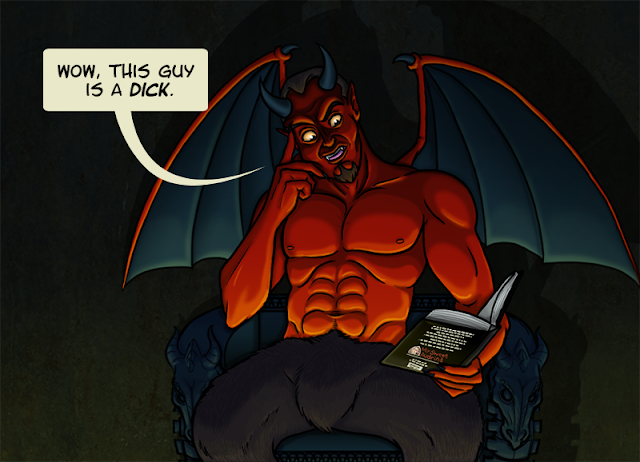
Satan is leaning back in his creepy dragon chair reading “My Sweet Audrina”. He has red skin, black horns, bat wings, furry goat legs, a goatee, and well-defined abs. The image is dark, and lit from below. Satan has a finger to his temple and comments “Wow, this guy is a DICK” (referring to Damian).
I just assume Satan is ripped
Audrina's mother, Lucietta, had to give up her dream of becoming a concert pianist to marry Damian (because he didn't want his wife to make more money than him), and now hides her misery by living in denial and drinking to numb the pain. She frequently lashes out at her sister, Ellsbeth, who has become bitter (again, thanks to Damian) and abusive, neglecting her own daughter, Vera. In turn, Vera has turned into a complete monster before the start of the book because nobody loves her and Damian (whom she sees as her father) constantly treats her like shit and compares her to his "perfect" daughter, Audrina. As horrible as Vera is (and she's pretty fucking horrible), you can't help but feel sorry for her. She's forced to be the whore to Audrina's virgin, which makes her hate and resents her cousin. She's so desperate for love and attention that 14-year-old Vera has "sex" with an adult man (everyone acts like it's consensual sex when it's very clearly statutory rape), and acts seductively from a young age. Of course none of the adults think "Hey, this isn't normal behavior for a child, maybe we should get her some help" they just decided "She's just a slut, oh well, who cares." Meanwhile Audrina is haunted by memories of a childhood rape, which her father keeps forcing her to remember in a sick attempt to make her "perfect" (I'm not even going to try and explain Damian's troll logic on this one). He reinforces her role as the virgin by frequently telling his daughter that all men are evil and forcing her to cover up in old fashioned dresses lest she be attacked. Is it any wonder Audrina becomes terrified of sex and disgusted by nudity to the point that she can't even be intimate with someone she loves without trauma? Of course Damian is totally fine with this because it means she's less likely to have a relationship with any man that isn't him. If that makes your skin crawl, well, it should, because even Audrina describes their relationship as being like husband and wife without the sex. Ew. At least there isn't any actual incest like I was fearing, which is a first for a V C Andrews novel. 

Even Lucietta isn't safe from her husband's slut shaming, as Damian flies into a rage if her outfits are too revealing and accuses her of flirting with the men at the parties he forces her to host. He wants to show off his pretty wife, but then gets ridiculously jealous when other men think she's pretty and ends up throwing a tantrum. He loves to be surrounded by women who adore him, but doesn't want to share, so everyone is essentially trapped in this giant, run down house where Damian can keep an eye on them, isolated from the rest of the world. Like I said, the dude is fucking evil, and doesn't even realize it. Or maybe he does, but simply doesn't give a shit. Basically, if there was a drinking game where you had to take a shot every time Damien pulls a dick move, no one would ever finish the book because they'd die from alcohol poisoning after a few chapters.

Now, you're probably wondering where the diversity comes in. I chose this book because of its representation of disability which, while not ideal (especially in Sylvia's case), was at least written by an author who herself had a physical disability for most of her life. As a teenager, Andrews developed severe arthritis and underwent multiple spinal surgeries to treat it. Andrews says this was the result of a back injury she sustained from falling on a staircase in high school, while her family claims it was something she was born with. Regardless, the resulting chronic pain required the use of a wheelchair or crutches for most of her life. Andrews lived at home, under the care of her mother, where she completed a four-year correspondence course in art, before starting her career as a writer. Her very first book, Flowers in the Attic, is about four children who are kept in the attic for years by their religious grandmother, and the toll it takes on their mental and physical well-being. Andrews said in a 1985 interview for Faces of Fear that Flowers in the Attic was based on her own feelings of frustration at being trapped at home. While accessibility for people with mobility issues still isn't great, I can imagine it was even worse when Andrews was growing up, and she died four years prior to the passing of the Americans with Disabilities Act. This theme of feeling "trapped" continues in My Sweet Audrina, where five of the six women in the story have some kind of disability that limits their freedom, which Damien of course takes full advantage of. Even the stairs that may or may not have been the start of Andrews' chronic pain and limited mobility feature prominently in the book. The Adere house's staircase essentially goes on a killing spree, offing multiple family members to the point where I have to wonder if the stairs were constructed from the bones of murdered children and cursed relics. Or maybe it's just haunted by all the ghosts of the people Damien pissed off (which I can only imagine is every person he's ever met). Andrews' representation of disability is definitely problematic, but also complex and extremely personal, which is what makes this story worth exploring. It's one of the few horror novels I've been able to find about disability that was actually written by a disabled person.

Vera has brittle bone disease, frequently breaking an arm or leg at the slightest bump. Audrina's younger sister, Sylvia has autism and/or an intellectual disability (it's not handled or explained well by Andrews) that requires full time care. Lucietta seems to have a heart disease that limits her activity. Billie, the Adere's neighbor and one of the few likable characters in the book, is a bilateral amputee following complications from diabetes. Then there's Audrina, whose untreated PTSD leaves her too terrified to leave her yard, even though she desperately wants to go to school and have friends. Audrina is sort of a Mary Sue for Andrews, what with her violet eyes, magically color changing hair, and extraordinary beauty (seriously, WTF?). They're both artistic, unable to leave the house, and need to rely heavily on their families to function which causes them great frustration. The depictions of women with disabilities in My Sweet Audrina aren't particularly progressive, and can even be downright ablest at time (especially when it comes to Sylvia), but the characters are all unique with very different personalities, outlooks, and ways of dealing with their disabilities.

I’m drawing a picture of Audrina. The first panel shows a stereotypically attractive woman in a white, conservative, Victorian dress. She has large, sparkly, violet eyes, and long rainbow hair that starts as red at her scalp, and moves down the spectrum to indigo and violet at the ends of her hair. In the second panel I’m looking at my creation with horror and ask, “The fuck did I just draw?” I’m wearing a purple shirt with bats that says “spoopy” in violet glitter.
 What Audrina looks like, presumable. Unrelated, but I wish I had that Spoopy shirt in real life.
Audrina desperately wishes for freedom and is frustrated by her PTSD, but without proper help and treatment she struggles to deal with her trauma (thanks a fucking lot, Damien). She does try to force herself to "get over it" a few times, and it doesn't go well. Vera, on the other hand, seems proud of her disability, bragging about her delicate bones and teasing Audrina for having "peasant bones", though it's most likely an act to make herself feel better. Vera will frequently play up her disability to get out of doing chores, and even purposely hurt herself for attention, even though her mother and Damien seem fairy unconcerned by her injuries. Billie, on the other hand, is ashamed of her residual limbs, and goes to great effort to hide them. Her husband left her after her legs were amputated, and she now sees herself as "damaged" and "unlovable" despite being drop-dead gorgeous and able to function just fine with the use of a wheeled board. Although Billie continues to live her life and seems pretty happy for the most part, she's still incredibly insecure, making her an easy target for Damien. Finally there's Sylvia, the youngest Adare daughter, who gets ignored and insulted by pretty much everyone except Audrina, her appointed caretaker. Because why would Damien get actual help when he can just make Audrina play Occupational Therapist for free? And then everyone seems ~shocked~ that Sylvia's not making much progress when she has a child (who only just started going to school herself) as her teacher. At least Sylvia gets some revenge on her awful family. It's never outright confirmed, but is strongly implied that she knows more than she lets on and allows people to underestimate her abilities so she can better manipulate them (and occasionally possibly murder them). Part of me really hopes Sylvia is knowingly screwing with everyone as a sort of "fuck you" to her neurotypical family who constantly calls her really ableist slurs and compare her to an animal, because they really fucking deserve it. Now if only she'd arrange for Damien to have a little accident....

My Sweet Audrina is a combination of exploitation horror and chick lit, meant to grab your attention from the first paragraph and brand its shocking subject manner deep into your brain so that years from now you'll still be thinking "God, that was a fucked up book." And if you're wondering why I would inflict this on myself, well, A) Because I'm a horror fan, that's kind of what I do, and B) It's just so damn enjoyable. It's a wonderful guilty pleasure I couldn't put down until the end, and Andrews is a talented writer who is fully aware of what she's creating. So what if the story can sometimes read like Soap Opera fan fiction written by a fourteen-year-old?  My Sweet Audrina is especially interesting when viewed as a personal exploration of the author's feelings of being "trapped' by her chronic pain and mobility issues.  For fans of tragic heroines, gothic horror, and guilty pleasures, I'd definitely recommend My Sweet Audrina.


Sunday, November 19, 2017

After the People Lights Have Gone Off by Stephen Graham Jones


Writing - 5, Horror -4, Diversity - 3


Formats - Print, digital

Publisher: Dark House Press

Genre:  Monster, Paranormal, Demon, Werewolf, Zombie, Killer/Slasher, Romance, Ghosts/Haunting, Sci-Fi Horror, Psychological Horror, Vampire
Audience: Adult

Tags: American Indian (Blackfoot/Niitsitapi), Queer (Gay Men), Disability (Paraplegic)

Takes Place in: US

Content Warnings: Animal Death, Child Endangerment, Child Death, Gore, Violence, Death, Torture, Homophobia, Self-Harm, Implied Sexual Assault (Highlight to view)
Blurb:
The fifteen stories in After the People Lights Have Gone Off by Stephen Graham Jones explore the horrors and fears of the supernatural and the everyday. Included are two original stories, several rarities and out of print narratives, as well as a few "best of the year" inclusions. In "Thirteen," horrors lurk behind the flickering images on the big screen. "Welcome to the Reptile House" reveals the secrets that hide in our flesh. In "The Black Sleeve of Destiny," a single sweatshirt leads to unexpectedly dark adventures. And the title story, "After the People Lights Have Gone Off," is anything but your typical haunted house story.

With an introduction by Edgar Award winner Joe R. Lansdale, and featuring fifteen full-page illustrations by Luke Spooner, After the People Lights Have Gone Off gets under your skin and stays there.


For Native American Heritage Month I’d thought I’d review a collection of short stories by one of horror’s greatest writers, Stephen Graham Jones.


Do you ever find yourself reading this awesome, interesting book, but then you get to the last chapter and go "What the fuck did I just read?" I'm not talking stories with ambiguous endings where it's left open to interpretation, like in Inception where it's unclear whether Cobb is still in a dream or not (and then you spend hours arguing about it on the internet), but the ending still makes sense. No, I'm referring to endings that are downright obfuscating (yay, I have a thesaurus!). Endings where you have to skip back to check if you missed some really obvious clue, only to find that no, the story really does end like that, and then you're left wondering if you're just not smart (or high) enough to "get it". For example, 2001: A Space Odyssey. I know it's this amazing, classic film, but what the hell was up with that giant space baby!?! Did the really obvious metaphor for the birth of humanity just fly over my head or did Kubrick just drop a bunch of LSD? Or both? Seriously WTF? Am I the only person who doesn't get it?

In the first panel a TV is showing a scene from 2001: A Space Odyssey with a giant, human fetus/star child floating in the void and looking at the planet earth. The second panel reveals me watching the film, bewildered, and asking “The hell is even happening right now?”
In retrospect, I probably shouldn't have tried watching this movie at 3 AM. 

Well, Stephen Graham Jones is a master of the WTF ending. In some ways this works to his advantage, like when it highlights the confusion and mental instability of the narrator, or preys on the reader's fear of the unknown. Subtle scares can be terrifying when done right, and when Jones gets it right, it works SO WELL, like with Second Chances where the final sentence of the story hits you like a punch in the gut. But Jones makes things too subtle you're left scratching your head and wondering what you're supposed to be scared of. It’s like when the creepy music starts playing in a film, you know you're supposed to feel uneasy because something bad is about to happen, but then, when the final dissonant chord is struck, everything just sort of ends without the payoff of a monster jumping out or even a terrified scream to imply something horrible just happened. Which is, unfortunately, really not that scary. After the People Lights Have Gone Off (the short story, not the book), Uncle, Xebico and Brush Monster all have this problem. Did someone die? Was there a monster? Is the narrator hallucinating? Did anything bad even happen? Am I just not smart enough to get it? It's especially frustrating when the rest of the story makes sense, like in Xebico, but then the ending just kind of goes off the rails. 


A sad, melting snow man with ear muffs, a whale with a bowtie shooting rainbows out of its blowhole, and a rabbit with a flower in its mouth, wearing a top hat and sunglasses are floating in midair and surrounded by sparkles. Looking uncomfortable, I ask, “Ummmm, so what am I supposed to be scared of? Is it the rabbit?”
I'm pretty sure it's the sketchy looking rabbit.
Of course, none of this makes Jones a bad writer. He's actually incredibly talented, aside from the whole confusing ending thing which is probably due more to me being obtuse than a lack of skill on Jones' part. Like King, Jones has a real flair for making the mundane fucking terrifying.  For example, The Black Sleeve of Destiny, which is about a Lovecraftian hoodie. That's right, a hoodie. Well, that and some poor kid's mild kleptomania spinning out of control until it becomes a full blown obsession, but mostly the evil hoodie that seems to act as a pocket dimension with a mind of its own. There's also The Spider Box (such a creepy title) about a cardboard fruit box that resurrects the dead.  Somehow Jones managers to cover all the horror staples in his book (demons, ghosts, werewolves, vampires, killers, and zombies) while still making his stories seem fresh and unique. A great example of this is Welcome to the Reptile House, one of the most distinct and creative vampire stories I've ever read. In fact, I didn't even know it was a vampire story when I started reading it, so, uh, sorry for the spoiler. 


Septa Unella from Game of Thrones is ringing her bell and chanting “shame, shame, shame”. Annoyed, I snap “Oh my God, it was one spoiler!”
Septa Unella shows up any time someone reveals a spoiler. Or at least, she SHOULD.
But not all the stories in this collection are your traditional tales of horror, some could even be considered love stories. Albeit, really messed up, creepy love stories, but love stories nonetheless. One story is even called This is Love. Jones explores different kinds of relationships in his novel, from lovers and devoted spouses, to childhood crushes, to familial love between siblings, parents and children, and even extended family. Snow Monsters is a heartwarming tale about what a parent will sacrifice for their child, but with a supernatural twist. Doc’s Story, explores the bonds of a struggling family, and is one of the most human stories in the collection, ironic since it's about werewolves.  In After the People Lights Have Gone Off (again, the short story, not the collection) and The Dead are Not we see examples of the complete devotion married couples have for each other, even when things get difficult and terrifying. Of course, there are also inversions, like Uncle, which is about a couple that has fallen out of love, and the husband's feelings of guilt for not mourning his wife's death.

Oh, and a little tip, before picking this book up I strongly recommend checking out Stephen King's short story The Man in the Black Suit and H. F. Arnold's The Night Wire (both of which you should read regardless because they're awesome). Why? Well The Spindly Man is a horror story about a book group discussing King's famous horror story (how's that for Inception?), while Xebico is about adapting The Night Wire to the stage. And as cheesy as having a scary short story about another scary short story sounds, they're both pretty awesome, yet another indicator of Jones' talent.

Overall, After the People Lights Have Gone Off (this time I am referring to the book) is an amazing anthology by a talented author, as long as you're okay with stream of consciousness writing and not always understanding what the hell you just read. Or maybe it's just me, and the rest of you will have some deeper understanding of the stories. Jones' work definitely makes me feel like I'm the only one at the party not getting the joke.