Showing posts with label Monster. Show all posts

Sunday, February 16, 2025

Malicia by Steven dos Santos

Malicia by Steven dos Santos. Recommended. Read if you like One Day at Horrorland by R.L. Stein


Formats: Print, audio, digital


Genre: Blood & Guts, Demon, Monster, Mystery, Myth and Folklore, Occult

Audience: Y/A

Diversity: Gay and bisexual man characters, Dominican Americans, character with anxiety disorder

Takes Place in: The Dominican Republic

Content Warnings: Ableism, Child Death, Death, Forced Captivity, Gaslighting, Gore, Medical Torture/Abuse, Mental Illness, Suicide, Torture, Verbal/Emotional Abuse, Violence, Vomit (Highlight to view)

Blurb:
Four friends, three days, two lovers, and one very haunted theme park.

On a stormy Halloween weekend, Ray enlists his best friends Joaquin, Sofia, and Isabella to help him make a documentary of Malicia, the abandoned theme park off the coast of the Dominican Republic where his mother and brother died in a mass killing thirteen years ago.


But what should be an easy weekend trip quickly turns into something darker because all four friends have come to Malicia for their own

Ray has come to Malicia to find out the truth of the massacre that destroyed his family. Isabella has come to make art out of Ray’s tragedy for her own personal gain. Sofia has come to support her friends in one last adventure before she goes to med school. Joaquin already knows the truth of the Malicia Massacre and he has come to betray his crush Ray to the evil that made the park possible.

With an impending hurricane and horrors around every corner, they all struggle to face the deadly storm and their own inner demons. But the deadliest evil of all is the ancient malignant presence on the island.

I received this product for free in return for providing an honest and unbiased review. I received no other compensation. I am disclosing this in accordance with the Federal Trade Commission’s 16 CFR, Part 255: Guides Concerning the Use of Endorsements and Testimonials in Advertising.

The story is told through alternating first-person perspectives between the four main characters; Raymundo, Joaquin, Sofia, and Isabella. The friends are traveling to spend Halloween weekend in Raymundo’s family’s abandoned, horror-themed amusement park, Malicia. The park was closed after a mysterious mass murder took place, claiming the lives of Raymundo’s mother and brother. The island on which Malicia was built is only accessible by boat, and there’s a massive hurricane headed right toward them, so good luck trying to escape if anything goes wrong. You may question the teens’ decision to go to what is very obviously a cursed murder island during a hurricane, but each of the four have their own reason for being there. Raymundo wants to try and summon his brother’s spirit, Isabella wants to film a documentary about the island, and Joaquin wants to sacrifice Raymundo because the cult he belongs to told him to. (Don’t worry, that’s revealed early in the story, so it’s hardly a spoiler.) Sofia is  there because her friends are, and because she very firmly doesn’t believe in the supernatural or scare easily.

I think the characters were somewhat underdeveloped and one-note, and the exposition felt awkward at times. But honestly, the characters were just an excuse to explore the super cool setting. I mean, an abandoned, horror-themed, cursed, amusement park? Could there be a more perfect location for a horror story? And Santos clearly put a lot of thought into describing Malicia in loving detail. There’s an entire map in the beginning of the book (and I’m a sucker for maps) showing the different areas of the park, like Serial Springs, Paranormal Place, and Creature Canyon. I also liked the ride descriptions, which all sounded like tons of fun.

Malicia strongly reminded meof the island setting in Umineko When They Cry, where the characters are trapped by a typhoon on a remote island that is slowly overtaken by the supernatural (and everyone there dies horrible deaths). As both stories progress, the scares move from strange shadows and murders that could’ve been committed by a human to horror that’s clearly the work of demonic forces.

I enjoyed how the author not only used Spanish frequently throughout the book (which I appreciate that the publisher did not italicize) but words and phrases specific to the Dominican. The friends name their little group the Quisqueya Club, a word of Taíno origin that refers to the inhabitants of Hispaniola. Raymundo and Joaquin refer to each other as pana and tiguere, the friends informally greet each other with “Qué lo que” (what’s up?), Raymundo calls his parents Mai and Pai, and he admits to himself that he’s a Jablador (liar). Many of the monsters are also specific to the Dominican like Los Biembiens and La Jupia. The four friends also prepare Dominican food like mangú and yaniqueques.

Malicia an incrediblya spooky, gory, fun read. Even though it’s a 300+ page book, it felt like a quick read because the chapters are short and the suspense was able to grab my attention, although, admittedly, the story did drag a bit in the middle. The shifting viewpoints throughout the book helped build the suspense as the characters all started to become suspicious of each other. Because it was written for teens, it felt like a PG-13 horror movie with R-rated violence, which, of course, you can get away with in a book. The descriptions of mutilated bodies and rotting flesh are very graphic so this one is definitely not for the squeamish horror fan.

Thursday, May 9, 2024

Bury Your Gays: An Anthology of Tragic Queer Horror edited by Sofia Ajram

Bury Your Gays: An Anthology of Tragic Queer Horror edited by Sofia Ajram. Highly Recommended. Read if you like tragic queer horror.


Formats: Print, digital

Publisher: Ghoulish Books

Genre: Body Horror, Ghosts/Haunting, Killer/Slasher, Monster, Romance

Audience: Adult/Mature

Diversity: Queer and trans authors and characters

Content Warnings: Alcohol Abuse, Body Shaming, Bullying, Death, Drug Use/Abuse, Eating Disorder, Homophobia, Medical Torture/Abuse, Medical Procedures, Necrophilia, Police Harassment, Rape/Sexual Assault, Slurs, Suicide, Torture, Transphobia, Violence (Highlight to view)

Blurb:
A manifestation of ecstasy, heartache, horror and suffering rendered in feverish lyrical prose. Inside are sixteen new stories by some of the genre's most visionary queer writers. Young lovers find themselves deliriously lost in an expanding garden labyrinth. The porter of a sentient hotel is haunted within a liminal time loop. A soldier and his abusive commanding officer escape a war in the trenches but discover themselves in an even greater nightmare. Parasites chase each other across time-space in hungry desperation to never be apart. A graduate student with violent tendencies falls into step with a seemingly walking corpse. Featuring stories from Cassandra Khaw, Joe Koch, Gretchen Felker-Martin, Robbie Banfitch, August Clarke, Son M., Jonathan Louis Duckworth, M.V. Pine, Ed Kurtz, LC Von Hessen, Matteo L. Cerilli, November Rush, Meredith Rose, Charlene Adhiambo, Violet, and Thomas Kearnes.

I received this product for free in return for providing an honest and unbiased review. I received no other compensation. I am disclosing this in accordance with the Federal Trade Commission’s 16 CFR, Part 255: Guides Concerning the Use of Endorsements and Testimonials in Advertising.

An exquisite anthology of queer horror that boasts such talented authors as Cassandra Khaw, August Clarke, and Gretchen Felker-Martin, this collection contains something for everyone. In its pages, you’ll find alien fungi, body horror, dark fairytales, undead lovers, and lonely ghosts. Named for the common trope where gay characters often meet with untimely ends in mainstream media, this anthology subverts the trope by putting it in the hands of queer writers.

In Your Honor, I’d Like to Put You in the Shoes of One of Dr. Morehouse’s Thirty Proven Clients by M. V. Pine, a trans woman (although she’s never referred to as such) struggles to find gender-affirming care. It’s the 1970s and she’s been dishonorably discharged from the army for “mental health” reasons. Her family doesn’t support her. She refers to her genitals as “a tumor.” A tumor that’s benign (hence, no doctor will remove it for her) but still mortifying. Because she’d do anything to be rid of it, she becomes an easy mark for Dr. Morehouse, who performs dangerous back-alley vaginoplasties on trans women. His surgical room is dirty and he runs out of anesthesia halfway through the procedure. He doesn’t provide antibiotics or pain medication. But the woman would rather die than go another day living with her “tumor.”

This is a story is about what happens when people don’t have access to safe, gender-affirming care. In 2017 a trans woman known only as “Jane Doe” underwent a back-alley orchiectomy which caused her to lose large amounts of blood. Police arrested James Lowell Pennington, who had performed the procedure without a medical license. Doe defended Pennington stating "Arranging a back-alley surgery was out of pure desperation due to a system that failed me.” Why would someone risk their life for what seems like an elective procedure? A study published in JAMA that followed trans and non-binary youths ages 13 to 20 showed 60% reduction of depression and 73% reduction of suicidality in participants who had initiated puberty blockers and gender-affirming hormones compared to those who had not. Another study published in JAMA on gender-affirming surgeries among 27,715 trans and gender diverse adults showed a 42% reduction in psychological distress and a 44% reduction in suicidal ideation among those who were able to receive gender-affirming surgery compared to those who wanted to but could not. There are many such studies that show similar results. Access to safe, gender-affirming care is quite literally lifesaving and immensely improves quality of life for trans and gender diverse people.

Another story that touches on the desperation many trans people feel just to have access to gender-affirming care is Worth the Dying Shame by Matteo L. Cerilli. In it, trans men are being infected by tainted, counterfiet testosterone with a disease that causes their bodies to decay as if dead (a clear parallel to AIDS). They hide their Body Rot under heavy clothing, dark glasses, and face masks. This causes an already unaccepting public to further turn on trans men. With jobs drying up, friends abandoning them, and doctors no longer willing to prescribe testosterone, the men who are able to go back in the closet. Others are forced to buy their T on the black market since doctors are no longer willing to prescribe the real stuff, which carries an even greater risk of infection. The story follows two trans men who have become infected, Dimeshine and Rictus. Rictus chose to detransition because he can still pass for a girl, but Dimeshine continues to inject T despite the risk of decaying faster. Both turn to the dark web to try and slow their Body Rot, trusting the community more than they do hospitals (understandable considering how often healthcare fails trans people). The two argue over whether Dimeshine’s little brother, Ratty, who is still early in his transition, should use testosterone or not. Dimeshine is firmly against it, worried Ratty might become infected like he was, but Rictus argues that he can’t blame Ratty for wanting to die for something they both would have killed for. These stories are a solemn reminder of what happens when the healthcare system fails LGBTQIA+ patients. As someone who works in healthcare, I held both stories especially heartbreaking.

Surprisingly for a horror anthology, many of the stories were love stories. Editor Sofia Ajram states the collection “was created out of a desire to read stories about tragic queer love. Love that is broken, love that is toxic, and obsessive, and ill-fated. Love that is thwarted, as viewed through the lens of authors who are queer-identifying themselves.” Abusive relationships are too often played off as romantic (think Twilight and Hush Hush), so it’s nice to see those sorts of relationships being shown for what they are, even when the characters themselves can’t recognize it. While horrific in real life, villain protagonists and toxic relationships can be fascinating studies in fiction. I also enjoyed having imperfect, even villainous queer characters whose character faults aren’t tied to their sexuality.

In American Gothic by LC von Hessen, villain protagonist John Smith is a serial killer (although he’d never refer to himself as such since “those guys are losers”) who has an unfortunate habit of murdering his dates. It’s not premeditated, it just seems to happen. But one day, one of his victims, who he dubs “L,” comes back to life. Or rather, he reanimates, as he’s still technically dead. L has no memory of his time alive, so John weaves an ever changing, fictional history of their romance. As L slowly rots away, John falls deeper in love with him. As shown with his past crushes, John is more in love with the fantasy he conjures then the men themselves. L allows him to project his ideal partner on to a blank slate he can fall in love with, like some sort of twisted Pygmalion, whereas living men would frequently reject him for being unemotional or creepy. John is a selfish lover, viewing his partners only by what they can do for him rather than their needs. He stalks and harasses one of his exes to the point they delete all their social media, but John still views himself as the victim and wonders why he didn’t kill his ex. John wants L to live, not for L’s sake, but for his own. He even tells him, “I won’t let you die. You’re not allowed to die unless I want you to die.” His selfishness and obsessiveness reminded me of male stalkers who feel they’re owed something by the object of their affection and can’t understand the word “no.”

This Body is Not Your Home by Son M., Love Like Ours by C M Violet, and Fortune Favors Grief by Cassandra Khaw are also stories of men who kill their lovers. Domestic violence against men is rarely examined. Even though 1 in 10 men will experience intimate partner violence or stalking in their lifetime, DV is usually thought of as a women’s issue only. Research on domestic violence among LGBTQIA+ people is even more sparse, even though gay men experience higher rates of physical violence then straight men. So, it’s refreshing to see stories that focus on intimate partner violence in gay relationships. Some of the stories focus more on mental and emotional abuse rather than physical. Both Sardines by Gretchen Felker-Martin and Zero Tolerance by M. F. Rose deal with queer teenage girls who are bullied. The former is a body horror story about a fat girl struggling with her sexuality and the latter is about cyber bullying. In this case, it’s their non-romantic relationships that are toxic.

Cleodora by August Clarke is a more lighthearted tale that follows the romance between a beautiful sea monster and a sea captain. The Captain discovers the monster and claims her as her bride, naming her Cleodora after a prophetic river nymph (The Captain seems to conflate the nymph Cleodroa with Andromeda, a princess who was offered as a sacrifice to a sea monster and rescued by the Greek hero Perseus). She sees Cleodora as helpless, which may explain why the Captain has no qualms about marrying a monster, happily feeding her new bride live eels and listening to her stories of drowning men. Cleodora feels equally unthreatened, stating “It’s fortunate my true love is a woman, because women do not hurt each other.” Ironic, considering how the story ends. The story feels like the original, darker version of a German fairytale, with hints of selkie wife folklore and siren myths.

Not all the romances involve toxic relationships or unrequited love. Bad Axe by Ed Kurtz is a tragic love story wherein John loses his lover, Eric, to the lake at Bad Axe in Minnesota. They’re never able to recover the body, so John goes back to Bad Axe to drown himself so he can be with Eric again. A touching yet morbid story it shares similarities with the myth of Hero and Leander. Hero, a priestess of Aphrodite, throws herself out of her tower after her lover, Leander, drowns trying to swim to her. The tragedy in Bad Axe is that John and Eric have a beautiful relationship that was tragically taken from them and now John must try and navigate the world through his immense grief. Black Hole, a sci-fi story by November Rush, also centers around a beautiful relationship that’s torn apart, but this time it’s between two parasitic, sentient fungi. Despite not being human, their love is no less pure and real. Lost and Found by Charlene Adhiambo also deals with lovers being united in death, but in this case they didn’t know each other before they died. 

It’s an intense read-- many of the stories handle dark themes like transphobic healthcare systems, bullying, drug abuse, suicide and AIDS analogies--but a beautiful one, full of romance and tragedy. Remarkably, each one of the stories in Bury Your Gays is as strong as the last, and I’d be hard pressed to pick a favorite. Some broke my heart, others chilled me to the bone, and yet others were touching in a bittersweet way. But all left a lasting impression.

Tuesday, September 19, 2023

Never Whistle at Night edited by Shane Hawk and Theodore C. Van Alst Jr.


Never Whistle at Night edited by Shane Hawk and Theodore C. Van Alst Jr. Highly Recommended. Read if you like Indigenous horror.


Formats: Print, audio, digital

Publisher: Vintage

Genre: Ghosts/Haunting, Historic Horror, Killer/Slasher, Monster, Myth and Folklore, Occult, Psychological Horror

Audience: Adult/Mature

Diversity: Indigenous American (Alaskan Native, Pueblo, Comanche, White Earth Nation, Cree, Georgian Bay Metis, Mohawk, Cheyenne-Arapaho, Hidatsa Mi'kmaw, Cherokee, Tłı̨chǫ Dene, Hidasta, Mandan, Sosore, Sioux Penobscot, Chickasaw, Choctaw, Sicangu Lakota, Edisto Natchez-Kusso, Lipan Apache, Anishinaabe)

Content Warnings: Alcohol Abuse, Animal Death, Child Abuse, Child Endangerment, Death, Drug Use/Abuse, Forced Captivity, Gaslighting, Gore, Illness, Oppression, Mental Illness, Pedophilia, Racism, Rape/Sexual Assault, Sexual Abuse, Slurs, Torture, Verbal/Emotional Abuse, Violence (Highlight to view)

Blurb:
Many Indigenous people believe that one should never whistle at night. This belief takes many forms: for instance, Native Hawaiians believe it summons the Hukai’po, the spirits of ancient warriors, and Native Mexicans say it calls Lechuza, a witch that can transform into an owl. But what all these legends hold in common is the certainty that whistling at night can cause evil spirits to appear—and even follow you home.

These wholly original and shiver-inducing tales introduce readers to ghosts, curses, hauntings, monstrous creatures, complex family legacies, desperate deeds, and chilling acts of revenge. Introduced and contextualized by bestselling author Stephen Graham Jones, these stories are a celebration of Indigenous peoples’ survival and imagination, and a glorious reveling in all the things an ill-advised whistle might summon.


I received this product for free in return for providing an honest and unbiased review. I received no other compensation. I am disclosing this in accordance with the Federal Trade Commission’s 16 CFR, Part 255: Guides Concerning the Use of Endorsements and Testimonials in Advertising.

There are many recognizable names in this collection: Rebecca Roanhorse, Richard Van Camp, Cherie Dimaline, Mona Susan Power, Darcie Little Badger, and Waubgeshig Rice. There’s even a foreword by Stephen Graham Jones. But I was especially excited to be introduced to some new (to me) Indigenous authors.

The stories in the anthology vary from fun campfire stories about werewolves (Night Moves by Andrea L. Rogers) and ghosts (Night in the Chrysalis by Tiffany Morris) to more serious and disturbing tales about residential school sexual abuse (Sundays by David Heska Wanbli Weiden), mental health (The Prepper by Morgan Talty), stolen land (Limbs by Waubgeshig Rice), and missing and murdered Indigenous women (The Ones who Killed Us by Brandon Hobson). There were bits of Native languages sprinkled throughout the various stories, for example I learned Uguku is “owl” in Cherokee, Kwe’ is “hello” in Mi’kmaq, and Mahsi’ cho is “thank you” in Gwich'in. This felt especially nice to see since so many Native languages are endangered. I can’t possible review all the amazing stories within the collection (and they are all amazing), so I’ll focus on a few of my favorites.

Kushtuka by Mathilda Zeller is about an Alaskan Native woman named Tapeesa. Recently an obnoxious White man named Hank Ferryman and his son Buck have moved to the area to build a monstrous lodge full of stolen Native artifacts. Tapessa is sent to the lodge cook for one of Hank’s parties and on the way the grotesque man asks her to tell him a “Native story.” Tapeesa warns that telling stories after dark could catch the attention of a spirit, but Hank laughs this off as silly superstition. She tells him the story of the Kushtuka, a shape-shifter that can take human form and tries to lure people away. As predicted, the story summons a Kushtuka which attacks Hank’s lodge. We also see this idea of attracting the attention of evil spirits in Before I Go by Norris Black, where a woman’s grieving causes the Night Mother to appear and offer to bring back her dead husband (it doesn’t end well).  

One of the things I related to in Kushtuka was Tapessa being called “basically White” by Hank because her dad is White. As a biracial person myself, having others (especially White people) try and tell you your identity isa pet peeve of mine. Historically, I would’ve been considered Black since my father is Black (due to the “one-drop” rule which I discuss below), despite having light skin. Yet these days most White people label me White because I’m White-passing. In both cases, White people choose my identity for me without listening to what I have to say, much like Hank does for Tapessa.

In White Hills by Rebecca Roanhorse, a White woman named Marissa is judged for having “too much” Native blood by her White in-laws. Marissa is your typical rich, White woman. She’s married to a wealthy business man named Andrew, is very concerned with her appearance, and lives in an HOA neighborhood in a big house. After going to the country club to announce her pregnancy to her husband, Marrissa makes the mistake of mentioning she’s a small percentage of Native (in reference to not being offended by a racist mascot) and her husband becomes visibly upset. The next day Elayne, Andrew’s mother, takes Marissa to a “specialist” who has racist phrenology drawings on the wall. Elayne explains that she doesn’t want a “mutt” grandbaby who may be dark skinned and “savage” (despite Marissa being white). The way in which Elayne views Marissa’s child is very reminiscent of the “one drop” rule. The one-drop rule was a legal principle based on a form of hypodescent, the assignment of a mixed-race child to the ethnic group considered "lower status." In other words, anyone with Black ancestry (no matter how far back) was considered Black. There were strict classifications for mixed-race individuals that were given offensive names like “Mulatto” and “octoroon,” I discuss more about how this racist system allowed the US to hold up White supremacy here. I mentioned above how annoying it is when other people (especially White people) decide my identity for me, butit’s even worse when the government does it.

And this leads me to blood quantum. Blood quantum is highly controversial and personal, and since I’m not Indigenous and therefore shouldn’t weigh in on such a heated debate I will tread carefully and stick to the facts as best I can. If you’re not familiar, Blood Quantum laws were enacted by the United States government to determine if someone was considered Native or not dependent on their degree of Native ancestry. The first "Indian Blood law" was originally created in 1705 when the Virginia government wanted to limit the civil rights of Native people and people of Native descent. Some Native tribes continue to use blood quantum to determine who can enroll for tribal membership, others do not. Leah Myers, a member of the Jamestown S’Klallam tribe, gives an example of the importance of tribal enrollment in her Atlantic essay:

"Tribal citizenship is more than symbolic. It determines eligibility for educational assistance, medical care, and other social benefits. Plus, only members can attend citizen meetings and vote in tribal elections. If my future children don’t meet the blood requirements for my tribe, they could still participate in events, cultivate plants in the traditional-foods garden, and take Klallam-language courses. But no matter how much they served the community in love and time, they would be deemed a 'descendant' and marked as separate."

Here’s a guide to Blood Quantum that gives both the arguments for and against blood quantum (full transparency, most Native sources I looked up were against these laws). Basically, blood quantum proponents argue that getting rid of blood quantum rules will make scarce resources even scarcer due to population growth and that it will allow disconnected outsiders and pretendians to join the tribe, which will erode their culture. Opponents of blood quantum argue that statistically it will eradicate Native nations, and point to the law's racist origins which were intended to control and erase Indigenous people. It also makes relationships complicated, as Indigenous people must calculate their potential children's percentage of Native blood and if they can enroll or not, which can put a strain on families. Blood quantum also conflicts with traditional Indigenous ideas about kinship and has“no basis in Native American traditions.” Essentially, both proponents and opponents disagree on the best way to preserve their tribal nations.

This idea is explored more fully in the story Quantum by Nick Medina. A woman named Amber is so obsessed with blood quantum and getting her children on the tribal roll that she favors her son Grayson, who’s 5/16 Native, while ignoring his brother Sam, who is only 1/8 Native, to the point where Sam is practically feral. She even tries to steal blood from a deceased Native man from their tribe so she can inject it into Sam.

Another story I enjoyed is Collections by Amber Blaeser-Wardzala, an incredibly creepy story about collecting human remains. Professor Smith, a liberal White woman, collects the heads of all the students she’s helped. She’s very proud of her collection: she has all the sexualities and genders, all the religions, and almost all the races. An Indigenous head would be her “white whale.” Megis (called Meg by the White professor) is understandably horrified by the collection, as is one of her Black classmates, but none of her white classmates seem to be. Professor Smith implies she wants to help Megis so she can have her head for her collection. Megis, the first person in her family to go to college, is desperate to stay on Professor Smith’s good side so she can maintain her scholarship and get a good job, and therefore doesn’t have much choice but to stay in the house of horrors. While an extreme example, the story underlines how troubling it is when museums collect human remains without consent and how academics will treat bodies as mere curiosities

“When [Native American artifacts and human remains] were acquired, collectors weren’t thinking of Indigenous peoples as human beings. People were resources, and human remains were to be preserved alongside pots” says Jacquetta Swift, the repatriation manager for the National Museum of the American Indian and member of the Comanche and Fort Sill Apache tribes. It’s the unfortunate reality that most human remains on display and in private collections, are unethically sourced from BIPOCs against their wishes.

This theme is also lightly touched on in Navajos Don’t Wear Elk Teeth by Conley Lyons where a Native man named Joe has a summer fling with White man named Cam. Cam collects teeth, some of which turn out to be human (he claims his last boyfriend was a Navajo man who gave him an elk tooth for “good luck” which Joe is dubious about). One of Joe’s friends refers to this as “bad medicine” and suggest Joe get an elder to sage his house. 

Not all the stories are quite so dark, however. Snakes are Born in the Dark by D. H. Trujillo felt like a Goosebumps book or a fun story kids tell to scare each other, and I thoroughly enjoyed it. In the story, an Alaskan Native boy named Peter goes hiking in the woods with his white cousin Maddie and her rude boyfriend Adam. They come across Native petroglyphs in the Four Corners desert which Maddie and Adam both immediately touch. Peter warns them not to touch the carvings but Adam continues to do so while mocking him. Unsurprisingly both Maddie and Adam suffer unpleasant (though non-lethal and impermanent) fates which results in a humorous ending. It’s a fun twist on the classic “Indian curse” where we (and Peter) are rooting for the White people to get their comeuppance.

I could go on and on about the stories in the anthology, like Hunger by Phoenix Boudreau where two Cree college girls, Summer and Rain, outsmart a Wehtigo. Or Scariest. Story. Ever. By Richard Van Camp that touches on who gets to tell Native stories and how to share culture without stealing it. They’re all great. I also felt like I learned a lot while reading the anthology.


Thursday, March 2, 2023

Crescentville Haunting by M.N. Bennet

Crescentville Haunting by M.N. Bennet. Recommended.Read if you like Y/A Paranormal romance, monsters, urban fantasy


Formats: Digital

Publisher: Self published

Genre: Ghosts/Haunting, Monster, Occult, Romance, Vampire, Werewolf, Zombie

Audience: Y/A

Diversity: Bisexual main character, non-binary minor character, Black major-character

Content Warnings: Child Death, Child Endangerment, Death, Forced Captivity, Gaslighting, Homophobia, Medical Torture/Abuse, Mental Illness, Oppression, Police Harassment, Torture, Verbal/Emotional Abuse, Violence (Highlight to view)

Blurb:
Determined to pass junior year, Logan won’t let Henry distract him—much. Logan’s focusing on all things human, which means his swoony vampire ex-boyfriend will have to file his own fangs for a change. When he goes to the school bonfire and runs into Henry, wandering into the woods seems like a great escape. Until he’s bitten by a wicked Crone with some twisted magical munchies.

Logan is certain his ex-free human future is done when he’s dragged off to a scientific institution for study. There, he’s presented with an opportunity to keep his life, family, and future. All he has to do is stick to human ideology, since all things paranormal are illegal. But complications arise when the Crone begins to haunt him and Logan realizes that if he wants to get his life back, he has to navigate his lingering feelings for Henry.

With the Crone set on devouring him and the institution ready to obliterate him for any missteps, Logan must decide between pursuing the human future his family wants—one that he thought he wanted too—or the chance to embrace Henry, even if the world isn’t ready.


I received this product for free in return for providing an honest and unbiased review. I received no other compensation. I am disclosing this in accordance with the Federal Trade Commission’s 16 CFR, Part 255: Guides Concerning the Use of Endorsements and Testimonials in Advertising.

Logan just wants a safe, normal, drama-free junior year, and that means avoiding his vampire ex, Henry, at all costs. Which is easier said than done. Logan may be shy and awkward, but Henry is his complete opposite: confident, outgoing, and suave. When his best friend Kiera (a phantom) drags him to a bonfire party that’s supposed to help Logan relax, he discovers that trouble has a way of following him. Not only is Henry there, but Logan is attacked (for the second time since he first started dating Henry) by a powerful creature, this time a monstrous witch known as the “Crone.” After sustaining a bite from the Crone, Henry’s life changes forever.

Henry and Kiera are known as Vices, a group of monsters including phantoms, witches, vampires, trolls, sirens, and werewolves that are forced to live in the shadows due to public fear and draconian laws. The Crone is a sin, a powerful Vice that feeds on other Vices and can turn humans into undead monstrosities called Hauntings (think zombies and ghouls) with a single bite. After Henry’s attack he’s whisked away by SPU agents (the special police force in charge of catching and neutralizing Sins) to a secure facility designed to treat Hauntings, but to everyone’s surprise he doesn’t transform into a Haunting. It turns out Henry is a rare form of Vice, known as a Viceling, more human than Vice. The lore of Crescentville Haunting can get confusing in places, and there’s a lot of backstory. So much so that I actually checked to see if there was a prequel I had missed. But it’s no worse that any other fantasy novel with rich world building. If you can remember the rules of Quidditch, you can remember the magical classification system Bennet has created.

The characters are relatable and their voices sound authentic. The romance is steamy without being explicit and felt age appropriate for younger teens. It should be noted that while the book contains a paranormal romance, it’s not the central theme of the story. Instead, we focus on Logan’s struggles with his new identity and trying to fit into a human-centric world-- an analogy for trying to fit into a heteronormative society when you’re LGBTQIA+. In Monsters in the closet: Homosexuality and the Horror Film Harry M. Benshoff writes “monster is to ‘normality’ as homosexual is to heterosexual.” LGBTQIA+ scholars have long equated queerness with fictional monsters and stories like Crescentville Haunting reclaim the “monstrous queer.” In Bennett’s story, the “homosexual vampire is the hero rather than the villain, with the humans representing an oppressive heteronormative society and the facility attempting to “cure” Logan of his monstrousness a metaphor for conversion therapy. In addition to romance, the book also has plenty of horror, violence, and suspense, all courtesy of the Crone who continues to haunt Logan after the initial attack.

Overall, this was a fun read with a good world building, a cute relationship, and teens who actually sounded and acted like teens.

Sunday, October 16, 2022

Brutal Hearts by Cassie Daley


Formats: Print

Publisher: Self Published

Genre: Killer/Slasher, Monster

Audience: Y/A

Diversity: Autistic character, author is queer and autistic

Content Warnings: Cannibalism, Child Death, Death, Gore, Violence (Highlight to view)

Blurb:
It's 1997 and Leah just can't seem to catch a break.

A year has passed since her fiancé went missing while hiking alone on a mountain, and she can't shake the unanswered questions and nightmares Simon left behind.

On the anniversary of his disappearance, Leah and her new girlfriend Josie return to the trail where Simon disappeared with two of their best friends. Armed with incense, tarot cards, crystals, and snacks, the girls have everything they need to complete the Ritual of Closure to help Leah finally say goodbye to Simon, once and for all.

But the trails are hiding something sinister, and it's been waiting. As night falls around them, the girls find themselves in a deadly game against something vicious and wild that's made a home for itself on the mountain.

It's time to find out what really happened to Simon.

The year is 1996: Scream has just been released in theaters, the Macarena is the hottest new dance craze, and seventeen-year-old Leah is deeply in love with her high school sweetheart, Simon. The two have plans to marry after graduation, but that dream is destroyed when Simon goes missing after a hike in the nearby mountains. Volunteers scour the woods for any trace of the missing boy, but it’s like Simon has vanished without a trace.

A year later, Leah is still struggling with her grief and guilt. Her girlfriend, Josie, is doing her best to help Leah through the nightmares and sobbing fits, but nothing seems to help. In a last-ditch effort to give the poor girl some closure, Josie suggests they hike Simon and Leah’s favorite trail to say a final goodbye. Along with Leah’s two best friends, sisters Charlotte and May, the girls set off to perform a Wiccan inspired goodbye ceremony for him. But their beautiful day quickly goes south when something in the woods starts stalking them.

Brutal Hearts is short but gripping story, switching back and froth between the girls being stalked through the woods and the mystery surrounding Simon’s disappearance. I ended up finishing it in one sitting, something I never do even with novellas (ADHD makes it hard for me to focus on a book for too long unless I’m really engaged). I loved all the little nods to 90s aesthetics, from the clothing, to May’s Tamagotchi and the girls’ obsession with all things Wicca. (From Sabrina Spellman to Nancy Downs witches were huge in the 90s, inspiring a renewed interest in Wicca from teenage girls.) Although, it is hard to accept that the 90s were thirty years ago and are now officially nostalgic. Wasn’t it literally just 2000? I think Y2K caused my brain to crash and stop perceiving the passage of time.

I especially liked the addition of the playlists for each character in the back of the book. Leah’s music playlist revolves around being hurt by love. Josie likes grunge. May’s playlist is full of bubblegum pop while the more traditionally pretty and popular Charlotte prefers mainstream music. A fun flashback to 90s teen horror like Fear Street and the works of Christopher Pike (appropriate since Daley also runs the PikeCast) with a healthy dose of urban legends and campfire stories. A perfect read for a hot summer night. 

Monday, February 28, 2022

Conquer by Edward M. Erdelac

Conquer by Edward M. Erdelac. Recommended. Read if you like Sugar Hill, Shaft, The Dresden Files

Formats: Print, digital, audible

Publisher: Self Published 

Genre:  Historic Horror, Monster, Mystery, Myth and Folklore, Occult, Vampire

Audience: Adult/Mature

Diversity: Black/African-American, Hispanic, Trans, Gay

Takes Place in: Harlem New York, NY, USA

Content Warnings: Animal Death, Body Shaming, Child Abuse, Death, Drug Use/Abuse, Forced Captivity, Gore, Homophobia, Kidnapping, Necrophilia, Oppression, Pedophilia, Physical Abuse, Police Harassment, Racism, Rape/Sexual Assault, Sexual Abuse, Slurs, Transphobia (Highlight to view)

Blurb:
In 1976 Harlem, JOHN CONQUER, P.I. is the cat you call when your hair stands up...the supernatural brother like no other. From the pages of Occult Detective Quarterly, he's calm, he's cool, and now he's collected in CONQUER.

From Hoodoo doctors and Voodoo Queens,
The cat they call Conquer’s down on the scene!
With a dime on his shin and a pocket of tricks,
A gun in his coat and an eye for the chicks.
Uptown and Downton, Harlem to Brooklyn,
Wherever the brothers find trouble is brewin,’
If you’re swept with a broom, or your tracks have been crossed,
If your mojo is failin’ and all hope is lost,
Call the dude on St. Marks with the shelf fulla books,
‘Cause ain’t no haint or spirit, or evil-eye looks,
Conjured by devils, JAMF’s, or The Man,
Can stop the black magic Big John’s got on hand!

I received this product for free in return for providing an honest and unbiased review. I received no other compensation. I am disclosing this in accordance with the Federal Trade Commission’s 16 CFR, Part 255: Guides Concerning the Use of Endorsements and Testimonials in Advertising.

Conquer is the story of a Black mystical detective named John Conquer (a reference to John the Conqueror) and a homage to 70’s detective fiction and Blaxploitation films. It’s fun, well written, and full of creepiness, including a fetus monster haunting an abandoned subway station and a man shrunk down and boiled alive in a lava lamp. I greatly enjoyed the book, but like most Blaxploitation, it wasn’t without its problems.

It’s important to point out that Erdelac is a White author writing a Black story (something not uncommon in Blaxploitation). I usually prefer to promote “own voices” books, and stories by cishet White men are a rarity on this blog. After all, folks with privilege do not have the best track record when it comes to writing marginalized groups. As Irish author Kit de Waal said, “Don’t dip your pen in someone else’s blood”. Take American Dirt by Jeanine Cummins and The Help by Kathryn Stockett. They’re both terrible for numerous reasons including, but not limited to: not doing enough research, using the White Savior trope, watering down their narratives to make them palatable for White audiences, cultural appropriation, speaking over marginalized voices, etc. That’s not to say White authors shouldn’t write BIPOC characters at all. Not having any diversity in your story can be equally problematic. It just needs to be done carefully and respectfully. Very, very carefully. Yes, I know that can be a fine line to walk, but if an author can research what kind of crops people were growing in 1429 to make their book more accurate, they can research American Indians and people of color. Besides, that’s what hiring sensitivity readers and using resources like Writing with Color is for. Of course, there’s also the problem of White voices being given preferential treatment by publishers and audiences over BIPOC trying to tell their own stories.

To his credit, Erdelac has done an impressive amount of research to make his book feel authentic. John Conquer wears a dime around his ankle for protection and a mojo hand (another name for a mojo bag) for luck. His name is a reference to High John de Conqueror, a Black folk hero with magical abilities. Conquer also has one of the most accurate representations of Vodou I’ve ever seen in fiction. Hollywood “voo doo” is a pet peeve of mine, so I appreciate Erdelac’s dedication to portraying the religion and loa/lwa (the powerful spirits Vodou  practitioners worship and serve) accurately. He also doesn’t try to portray an idealized version of 1970s NYC. There’s racism, anti-Semitism, homophobia, and cops and criminals spewing slurs. And while it’s jarring, it does make the story feel more authentic. The police are racist and homophobic and there’s tension between the many communities that make up 1970s New York. John Conquer’s Uncle Silas was disowned by his family for being gay, and when John is asked to solve his murder, he has to confront his own homophobia and transphobia. That doesn’t mean it always works, though. There were definitely a few times I side-eyed and wondered if a certain line really needed to be in there.

My favorite part of the book is Eldelac’s excellent world building. White vampires go up in smoke when exposed to sunlight, while vampires with more melanin are protected from the sun’s rays. Vampirism also halts a corpse’s decay, but all that rot catches up to them when they’re finally killed. Each culture has their own magical practices with distinct rules, and magic doesn’t cross cultural lines. For example, only Vodou practitioners can become zombies, and non-Christian vampires are immune to crosses. Conquer is especially powerful because he’s learned many different traditions and practices, but the catch is that this opens him to a wider variety of spiritual attacks. Street gangs utilize black magic to wage wars with each other. His work is clever, original, and something I could really get into. But…having White authors tell BIPOC stories still feels problematic to me when White authors are still so heavily favored by the publishing industry. I’ve reviewed books by White authors before, but because Conquer is based heavily on Blaxploitation it feels, well, more exploitative than those I’ve reviewed in the past. I’m still going to go ahead and recommend Eldelac’s work becausein the endit is well written and interesting, but I can also completely understand if some of you want to skip this one.

Thursday, October 28, 2021

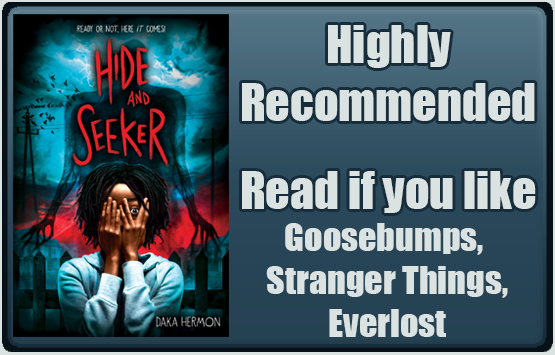
Hide and Seeker by Daka Hermon

Hide and Seeker by Daka Hermon.  Highly Recommended. Read if you like Goosebumps, Stranger Things, Everlost


Formats: Print, audio, digital

Publisher: Scholastic 

Genre:  Demon, Monster, Psychological Horror

Audience: Children

Diversity: Black author and characters

Takes Place in: Tennessee 

Content Warnings: Child Abuse, Child Endangerment, Death, Forced Captivity, Gaslighting, Police Harassment (Highlight to view)

Blurb:
One of our most iconic childhood games receives a creepy twist as it becomes the gateway to a nightmare world.

I went up the hill, the hill was muddy, stomped my toe and made it bloody, should I wash it? Justin knows that something is wrong with his best friend. Zee went missing for a year. And when he came back, he was . . . different. Nobody knows what happened to him. At Zee's welcome home party, Justin and the neighborhood crew play Hide and Seek. But it goes wrong. Very wrong. One by one, everyone who plays the game disappears, pulled into a world of nightmares come to life. Justin and his friends realize this horrible place is where Zee had been trapped. All they can do now is hide from the Seeker.

You'd think I'd eventually learn that kid's media can be just as scary as horror aimed at adults. After all, Over the Garden Wall, Coraline, and Skeleton Man all managed to scar me permanently. And yet, I went into Hide and Seeker foolishly assuming that it would be tame in comparison to my usual horror fare. Well, boy was I wrong. This book was INTENSE. I mean, just look at that cover! Suddenly I was a child again, hiding under the covers from the monsters in the darkness but still unable to put the book down despite the nightmares I knew it would cause. I haven't had a good scare like that in a while and it was absolutely wonderful. 


A cartoon of me watching TV. The TV screen shows a scene from "Over the Garden Wall." I'm sitting on the couch looking horrified.
Over the Garden Wall: nightmare fuel for the whole family!

Jason is coping with the death of his mother and the disappearance of his best friend, Zee. Despite support from his sister and counselor he still struggles to accept her death and deal with his panic attacks (major kudos to Hermon for portraying an accurate depiction of panic attacks and anxiety). Then Zee reappears suddenly, covered in scars and speaking in riddles about a monster called the Seeker. What should be a joyous occasion quickly turns sour when children in the neighborhood start to disappear after a game of hide & seek. Jason and his friends Lyric and Nia soon learn that the kids were whisked away by the demonic Seeker to a place beyond their worst nightmares, and it looks like they’re next.


Of our trio of heroes, I’d have to say Nia is my favorite. She’s clever, rational, and despite her photographic memory and love of trivia she struggles with schoolwork. It was a nice change of pace to see the token “smart kid” suck at test taking and homework, a reminder that schoolwork is not an accurate measure of intelligence and ingenuity, and learning disabilities don’t mean you’re stupid. Nia uses her wits to help the kids out of more than one scrape and pushes her friends to be their best. She also knows enough about horror movie tropes to advise against splitting up the group. Nia is awesome. Not that Lyric or Jason are slouches. They’re fiercely loyal to each other, and it’s incredibly heartwarming. Even at their worst moments, the kids stick together and support their friends. 

This is the perfect book for kids who love Goosebumps and Stranger Things but are still too young for Stephen King and R-rated Slashers. Hermon is amazing at creating atmosphere and building terror without relying on blood and gore (there are minor injuries though, like bug stings, burns, and minor cuts). Her dialogue conveys the intensity of the situation without swearing. By implying Nowhere is a place where all your greatest fears become real and leaves its victims traumatized and covered in scars, our imaginations are able to come up with the worst possible scenarios. Not that Hermon leaves everything up to the reader’s imagination: there are plenty of giant bugs, living dolls, needles, and rat-snake hybrids to convey how truly terrifying Nowhere is.


Justin faces a lot of scary things, but racists and systemic oppression aren't among them. It was nice to have a middle-grade book with a Black hero that didn’t deal with racism. Black folks already have to deal with racism All. The. Time. We deserve escapist stories where Black kids get to exist without having to worry about discrimination. Nic Stone, author of Dear Martin put it best in her article for Cosmopolitan:

“…I can’t help but wonder how different the world would look if we’d all grown up seeing Black people do the stuff White people did in books. Going on adventures. Saving the day. Falling in love. Solving mysteries. Dealing with a broken heart. Getting caught up in a riveting love triangle. Taking down oppressive regimes. (I mean, HELLO, a bunch of farm animals took down a dictatorial pig in a book that’s been on middle school curriculum lists for decades. Yet Black people can’t survive the first book in a dystopia trilogy?) What if we’d seen Black people in books just being human?”

The closest the book gets to dealing with racism is when the kids get harassed by a police officer while riding their bikes though a nice neighborhood. Ironically, it’s the one White kid in the group that hates cops the most due to his father being sent to prison for a crime he didn’t commit, and he warns the others not to ask the police for help. And it’s such a nice change to see Black kids fighting make-believe monsters rather than real ones. 

Tuesday, May 25, 2021

Anoka by Shane Hawk


Anoka by Shane Hawk. Recommended. Read if you like Tales from the Crypt. Creepypastas.

Formats: Print, audio, digital

Publisher: Link to book

Genre: Body Horror, Folk Horror, Monster, Myth and Folklore, Occult, Werewolf

Audience: Adult/Mature

Diversity: Biracial Cheyenne author, Dakota characters, non-binary character

Takes Place in: Anoka Minnesota, USA

Content Warnings: Alcohol Abuse, Cannibalism, Child Death, Death, Drug Use/Abuse, Gore, Racism, Rape/Sexual Assault, Self-Harm, Sexual Abuse, Slurs, Suicide, Verbal/Emotional Abuse, Violence (Highlight to view)

Blurb:
Welcome to Anoka, Minnesota, a small city just outside of the Twin Cities dubbed "The Halloween Capital of the World" since 1937. Here before you lie several tales involving bone collectors, pagan witches, werewolves, skeletal bison, and cloned children. It is up to you to decipher between fact and fiction as the author has woven historical facts into his narratives. With his debut horror collection, Cheyenne & Arapaho author Shane Hawk explores themes of family, grief, loneliness, and identity through the lens of indigenous life.

I received this product for free in return for providing an honest and unbiased review. I received no other compensation. I am disclosing this in accordance with the Federal Trade Commission’s 16 CFR, Part 255: Guides Concerning the Use of Endorsements and Testimonials in Advertising.

Apparently Anoka, Minnesota is the "Halloween Capital of the World" because they've been having giant Halloween parades since 1920. Out of civic pride, I want to argue that Salem is the Halloween Capital and our town is better because we have real witches and Salem Horror Fest and the oldest candy company in America. On the other hand, I would also like tourists to stop blocking the traffic, drunkenly climbing on the witch statue, and crowding my favorite restaurants every October (that's my job), so maybe it would be better if they all headed to Anoka instead. I don't think anyone will want to go anywhere near the Minnesota city after reading Shane Hawk's Indigenous horror anthology of the same name, though. The stories in Anoka are loosely tied together by their location in an alternative version of the town where dark magic and monsters lurk. An evil tome known simply as "the book" and strange green swirls also make multiple appearances throughout the anthology. 


A draw of me sitting on the broom of the Bewitched statue in downtown Salem MA. I'm drunkenly waving a purple cup around that says "Witch's Brew." I'm happily yelling "Wooooo! What up Witches! *hic*"
I may or may not have actually done this

Hawk gives a different and unique voice to each of his characters so every story feels different from the others. His writing reminded me of a talented artist who can draw in multiple styles and shift easily from realism to the simple lines of a cartoon. My favorite thing about his book is how so many of the stories felt like pre-comics code horror anthology comics like Eerie, Black Cat, and The Haunt of Fear or modern-day creepypastas with terrifying twists. Some stories were fun and weird, others tragic reflections of human nature. But all of them were creepy, the kind of creepy that makes you aware of how many noises an old house makes at night or has you shouting out loud at the characters not to go into the room where the monster is waiting. 

A drawing meant to look like an old horror comic cover. The comic's title is "Beware Anoka." On the cover a demonic Native child with yellow eyes is grinning while his fire looks on in horror.

American Indians tragically have the highest infant mortality rate in the U.S. (again due to trauma, poverty and a lack of adequate healthcare), so much of Hawk's anthology touches on themes of child death and the trauma that goes with such a great loss. In two stories, Orange and Wounded, the death of a child in the past moves the main characters to do something terrible. Soilborne is a metaphor for the loss of the child-parent connection and how devastating that can be. In Imitate, the protagonist has to rush to save his son, Tate, from an unknown horror that's taken his form. There's no way of knowing if Tate is even still alive, and the whole story is exceedingly stressful to read. Honestly, Imitate would have worked just fine as microfiction and Hawk could have easily ended it after the first page or so. But instead, he decides to pile on even more terror by turning it into a suspenseful short story where we're forced to watch a father slowly lose his mind. It's definitely one of the anthology's stronger and spookier tales. 

My absolute favorite story in the collection is Dead America about a writer named Chaska whose family is followed by death. This is sadly not uncommon for Native families as generational trauma, poverty, and a lack of adequate healthcare has lead to poor health and high death rates from heart disease, diabetes, and suicide. The story gets its name from Chaska's hobo nickel which depicts the skull of a dead Indian chief in full headdress on one side and Columbus' three ships on the other. "When betting a coin offers someone a fifty-fifty chance of winning and losing. The nickel was a metaphor for the predicament of Indian existence: fucked no matter which side the coin landed on" the author explains. He's about to find out how right he is when Asibikaashi the Spider Woman decides to make the Dakota author suffer for his sins. 

 This story is SCARY. All of my notes for Dead America consist of "nope, nope, nopeity-nope nope, fuck this, nope." I'm not someone who's usually bothered by spiders under normal circumstances. I think they're kind of cute and I love that they eat any bugs that get into the house, but Chaska's punishment left me terrified of arachnids. If you have any form of arachnophobia, I can guarantee you'll be in for some nasty nightmares and might want to skip this story entirely. But if you're feeling brave, it's one of the strongest stories in the collection and worth checking out. The story also touches on themes of profiting off the personal stories of others, very similar to how Ward ChurchillAsa Earl Carter, Mary Summer Rain and others pretended to be Native for fame and money.


A screenshot of Michael Scott from the Office saying "Nope. Don't like that."


It's important to note that in Ojibwe stories Asibikaashi, aka Grandmother Spider, is a benevolent deity and helper of humanity whose spiderweb charms, popularly known as "Dream Catchers", were woven by women as a form of protection for infants. I couldn't find any references to her punishing the wicked (of course I couldn't find many references to her at all that weren't written by White new agers). 

Hawk's final story, Transformation, is about a non-binary werewolf who hunts for her community and runs into trouble at Anoka's annual Halloween parade. Having a trans werewolf feels perfect because werewolves are the ideal metaphor for someone with a fluid identity. Sometimes you're a wolf, others a human, and occasionally you're something in between, but you're always a werewolf regardless of what form you take that day. Just because I'm femme one day, it doesn't negate the fact that I'm non-binary; I'm still an enby when I'm feeling more trans-masculine. Like the story title, werewolves can also represent transition. The wolf can be seen as the true self, hidden under a dull human skin that's forced to conform to society's rigid standards. Becoming the wolves gives you the opportunity to experience freedom. If that transformation is unwanted, it can be compared to a menstrual cycle that causes dysphoria each month or unwanted body hair. "Jenny" a transwoman who identifies with werewolves is quoted on the queer horror blog, Gender Terror"The titanic proportion of my body and the hair that I continually fight back terrify me, and makes me the target of many suspicious onlookers. And just like werewolves, I have no control over what my body does. Feeling like a prisoner to how your body changes is a special torment I think a lot of transgender people share with werewolves." So is it any wonder writers like Hal SchrieveAllison MoonSuzanne Walker,  Ashlynn Barker, and numerous self-published erotic authors like Noah Harris have all explored the idea of a trans werewolf? Heck "were-woman" is slang for someone who "transforms" into a woman at night (though this terminology can be problematic). Hawk's non-binary werewolf character seemed so cool I was disappointed that their story wasn't longer. There was so much going on in Transformation it felt like it would've worked much better as a novella rather than a short story. Honestly, I'd read a full novel about the nostalgic werewolf, Halloween parades, and Wendigo. That's my one major complaint about Anoka: it's too short! The concept was so cool I was disappointed we didn't get to explore more of Hawk's alternate universe. I wanted to learn more about The Book and the creepy town filled with dark magic and monsters. 

A werewolf with top surgery scars and trans pride flag boxers is standing in a dark, foggy forest.
Transwolves eat TERFs for breakfast

What impressed me the most about the story collection is how Hawk was able to handle the subjects of child losssexual assaultsubstance abuse and missing and murdered Indigenous women, especially in his story Wounded, in a way that felt respectful rather than exploitative. Anoka is a fun, frightening ride that draws attention to many of the issues plaguing American Indians today, and I hope we'll get to hear even more stories from the spooky little town in Hawk's future books.