Showing posts with label Blood & Guts. Show all posts

Sunday, February 16, 2025

Malicia by Steven dos Santos

Malicia by Steven dos Santos. Recommended. Read if you like One Day at Horrorland by R.L. Stein


Formats: Print, audio, digital


Genre: Blood & Guts, Demon, Monster, Mystery, Myth and Folklore, Occult

Audience: Y/A

Diversity: Gay and bisexual man characters, Dominican Americans, character with anxiety disorder

Takes Place in: The Dominican Republic

Content Warnings: Ableism, Child Death, Death, Forced Captivity, Gaslighting, Gore, Medical Torture/Abuse, Mental Illness, Suicide, Torture, Verbal/Emotional Abuse, Violence, Vomit (Highlight to view)

Blurb:
Four friends, three days, two lovers, and one very haunted theme park.

On a stormy Halloween weekend, Ray enlists his best friends Joaquin, Sofia, and Isabella to help him make a documentary of Malicia, the abandoned theme park off the coast of the Dominican Republic where his mother and brother died in a mass killing thirteen years ago.


But what should be an easy weekend trip quickly turns into something darker because all four friends have come to Malicia for their own

Ray has come to Malicia to find out the truth of the massacre that destroyed his family. Isabella has come to make art out of Ray’s tragedy for her own personal gain. Sofia has come to support her friends in one last adventure before she goes to med school. Joaquin already knows the truth of the Malicia Massacre and he has come to betray his crush Ray to the evil that made the park possible.

With an impending hurricane and horrors around every corner, they all struggle to face the deadly storm and their own inner demons. But the deadliest evil of all is the ancient malignant presence on the island.

I received this product for free in return for providing an honest and unbiased review. I received no other compensation. I am disclosing this in accordance with the Federal Trade Commission’s 16 CFR, Part 255: Guides Concerning the Use of Endorsements and Testimonials in Advertising.

The story is told through alternating first-person perspectives between the four main characters; Raymundo, Joaquin, Sofia, and Isabella. The friends are traveling to spend Halloween weekend in Raymundo’s family’s abandoned, horror-themed amusement park, Malicia. The park was closed after a mysterious mass murder took place, claiming the lives of Raymundo’s mother and brother. The island on which Malicia was built is only accessible by boat, and there’s a massive hurricane headed right toward them, so good luck trying to escape if anything goes wrong. You may question the teens’ decision to go to what is very obviously a cursed murder island during a hurricane, but each of the four have their own reason for being there. Raymundo wants to try and summon his brother’s spirit, Isabella wants to film a documentary about the island, and Joaquin wants to sacrifice Raymundo because the cult he belongs to told him to. (Don’t worry, that’s revealed early in the story, so it’s hardly a spoiler.) Sofia is  there because her friends are, and because she very firmly doesn’t believe in the supernatural or scare easily.

I think the characters were somewhat underdeveloped and one-note, and the exposition felt awkward at times. But honestly, the characters were just an excuse to explore the super cool setting. I mean, an abandoned, horror-themed, cursed, amusement park? Could there be a more perfect location for a horror story? And Santos clearly put a lot of thought into describing Malicia in loving detail. There’s an entire map in the beginning of the book (and I’m a sucker for maps) showing the different areas of the park, like Serial Springs, Paranormal Place, and Creature Canyon. I also liked the ride descriptions, which all sounded like tons of fun.

Malicia strongly reminded meof the island setting in Umineko When They Cry, where the characters are trapped by a typhoon on a remote island that is slowly overtaken by the supernatural (and everyone there dies horrible deaths). As both stories progress, the scares move from strange shadows and murders that could’ve been committed by a human to horror that’s clearly the work of demonic forces.

I enjoyed how the author not only used Spanish frequently throughout the book (which I appreciate that the publisher did not italicize) but words and phrases specific to the Dominican. The friends name their little group the Quisqueya Club, a word of Taíno origin that refers to the inhabitants of Hispaniola. Raymundo and Joaquin refer to each other as pana and tiguere, the friends informally greet each other with “Qué lo que” (what’s up?), Raymundo calls his parents Mai and Pai, and he admits to himself that he’s a Jablador (liar). Many of the monsters are also specific to the Dominican like Los Biembiens and La Jupia. The four friends also prepare Dominican food like mangú and yaniqueques.

Malicia an incrediblya spooky, gory, fun read. Even though it’s a 300+ page book, it felt like a quick read because the chapters are short and the suspense was able to grab my attention, although, admittedly, the story did drag a bit in the middle. The shifting viewpoints throughout the book helped build the suspense as the characters all started to become suspicious of each other. Because it was written for teens, it felt like a PG-13 horror movie with R-rated violence, which, of course, you can get away with in a book. The descriptions of mutilated bodies and rotting flesh are very graphic so this one is definitely not for the squeamish horror fan.

Wednesday, July 12, 2023

The Spirit Bares Its Teeth by Andrew Joseph White

The Spirit Bares Its Teeth by Andrew Joseph White. Highly recommended. Read if you like medical horror, gothic schools


Formats: Print, audio, digital

Publisher: ‎Peachtree Teen

Genre: Blood & Guts, Body Horror, Ghosts/Haunting, Mystery, Gothic

Audience: Y/A

Diversity: Neurodiversity (Autism), transgender characters, queer character

Takes Place in: London, England

Content Warnings: Abelism, Animal Death, Bullying, Child Abuse, Child Death, Child Endangerment, Death, Forced Captivity, Gaslighting, Gore, Homophobia, Kidnapping, Medical Torture/Abuse, Medical Procedures, Miscarriage, Oppression, Pedophilia, Physical Abuse, Rape/Sexual Assault, Self-Harm, Sexism, Slurs, Slut-Shaming, Torture, Transphobia, Verbal/Emotional Abuse, Victim Blaming, Violence  (Highlight to view)


Blurb:
Mors vincit omnia. Death conquers all.

London, 1883. The Veil between the living and dead has thinned. Violet-eyed mediums commune with spirits under the watchful eye of the Royal Speaker Society, and sixteen-year-old Silas Bell would rather rip out his violet eyes than become an obedient Speaker wife. According to Mother, he’ll be married by the end of the year. It doesn’t matter that he’s needed a decade of tutors to hide his autism; that he practices surgery on slaughtered pigs; that he is a boy, not the girl the world insists on seeing.

After a failed attempt to escape an arranged marriage, Silas is diagnosed with Veil sickness—a mysterious disease sending violet-eyed women into madness—and shipped away to Braxton’s Finishing School and Sanitorium. The facility is cold, the instructors merciless, and the students either bloom into eligible wives or disappear. When the ghosts of missing students start begging Silas for help, he decides to reach into Braxton’s innards and expose its guts to the world—if the school doesn’t break him first.

Featuring an autistic trans protagonist in a historical setting, Andrew Joseph White’s much-anticipated sophomore novel does not back down from exposing the violence of the patriarchy and the harm inflicted on trans youth who are forced into conformity.

I received this product for free in return for providing an honest and unbiased review. I received no other compensation. I am disclosing this in accordance with the Federal Trade Commission’s 16 CFR, Part 255: Guides Concerning the Use of Endorsements and Testimonials in Advertising.

Silas is an autistic trans boy living in Victorian London who wants nothing more than to be a surgeon like his brother, George, and his idol James Barry. Unfortunately for Silas, the world still sees him as a young girl with violet eyes.

In White’s alternative history people born with violet eyes are Speakers, those who can open the Veil that separates the living and dead to communicate with ghosts. But only violet-eyed men are permitted to be mediums. It is believed that women who tamper with the Veil will become unstable and a threat to themselves and others. Veil sickness is said to be the result of violet-eyed women coming into contact with the Veil and is blamed for a wide range of symptoms from promiscuity to anger, but is really just the result of women who don’t obediently follow social norms. Thus, England has made it strictly illegal for women to engage in spirit work. After Silas’ failed attempt to run away and live as a man, he is diagnosed with Veil sickness and carted off to Braxton’s Finishing School and Sanitorium to be transformed into an obedient wife. Braxton’s is your typical gothic school filled with sad waifs and dangerous secrets, namely that girls keep disappearing. The headmaster is a creep and his methods for curing young girls are abusive. Despite the danger, Silas is determined to get to the bottom of the mysterious disappearances and find justice for the missing girls.

Violet-eyed women are highly valued as wives who can produce violet-eyed sons and are in high demand among the elite. Silas is no different, and his parents are eager to marry him off to any man with money. If being made to live as a girl weren’t bad enough, the idea of being forced to bear children is even more horrific to Silas. As someone who struggles with Tokophobia myself, I found White’s descriptions of forced pregnancy to be a terrifying and especially disturbing form of body horror. Because of Silas’ obsession with medicine, the entire book is filled with medical body horror. There are detailed descriptions of injuries and surgeries, medical torture, and an at-home c-section/abortion. Personally, I loved all the grossness and the detailed descriptions of anatomy and medical procedures. But The Spirit Bares its Teeth is most definitely not for the squeamish or easily grossed-out. I appreciated that in the afterword White made a point of mentioning that in the real world, it was usually racial minorities who were the subject of medical experimentation (rather than wealthy White women), and then recommended the books Medical Apartheid by Harriet A. Washington and Medical Bondage by Deirdre Cooper Owens for readers to learn more.

I was also happy to see an autistic character written by an autistic author. Stories about Autistic individuals often are told by neurotypical people who characterize autism as “tragic” or as an illness that needs to be cured. In The Spirit Bares its Teeth, neurodiversity is humanized and we see how harmful a lack of acceptance and understanding of autism is. Silas is forced to mask by society, and we see how difficult and harmful masking is to him. He is taught by his tutors to ignore his own needs in favor of acting the way others want. They reinforce the idea that acting “normal” (i.e. neurotypical) is the only way anyone will tolerate him. Silas’ tutors use methods similar to the highly controversial Applied Behavior Analysis (ABA) to force him to behave in a manner they deem appropriate. He is not allowed to flap his hands, pace or cover his ears at loud noises, and is forced into uncomfortable clothing that hurts his skin and to eat food that makes him sick. He is mocked for taking things literally and punished if he can’t sit still and keep quiet. It’s horrible and heartbreaking.

Although I’m not autistic, I do have Attention Deficit Disorder (ADD), a condition which has many overlapping symptoms with autism, including being easily overstimulated by sensory input. I have texture issues and White’s description of the uncomfortable clothing Silas is forced into made my skin itch in sympathy. It sounded like pure hell, and poor Silas can’t even distract himself with stimming so he just has to sit there and endure it. After meeting a non-verbal indentured servant whose autistic traits are much more noticeable, he also acknowledges that his ability to mask gains him certain privileges as he can “pass” as neurotypical (even though he should never have to pass in the first place and doing so is extremely harmful to his wellbeing).

In addition to its positive autism representation, White also does an excellent job portraying the struggles of being a trans person forced to live as their assigned gender. Interestingly, this is the first book with a transgender main character I’ve read where said character isn’t fully out or living as their true gender. Part of the horror of the story is that Silas can’t transition as he’s in an unsupportive and abusive environment. I also found it interesting that Silas is both trans and autistic as there’s an overlap between autism and gender identity/diversity.

The Spirit Bares its Teeth is a suspenseful and deeply disturbing gothic horror story about misogyny, ableism, and how society tries and controls women. I was absolutely glued to this story and could not put it down, no easy feat when my ADD demands constant distraction. Each revelation was more horrifying than the last and by the end I was terrified of what secrets Silas would uncover next. 

Wednesday, October 20, 2021

The Butcher's Wife by Li Ang Translated by Howard Goldblatt and Ellen Yeung


The Butcher's Wife by Li Ang. Highly Recommended. Read if you like feminist horror. Taiwanese history.

Formats: Print, digital

Publisher: Peter Owens

Genre: Psychological Horror, Blood & Guts, Historic Horror

Audience: Adult/Mature

Diversity: Taiwanese characters and author

Takes Place in: Taiwan

Content Warnings: Alcohol Abuse, Animal Abuse, Animal Death, Body Shaming, Bullying, Death, Gore, Illness, Sexism, Slut-Shaming, Police Harassment, Physical Abuse, Rape/Sexual Assault, Sexual Abuse, Attempted Suicide, Verbal/Emotional Abuse, Victim-Blaming, Violence (Highlight to view)

Blurb:
Chen Jiangshui is a pig-butcher in a small coastal Taiwanese town. Stocky, with a paunch and deep-set beady eyes, he resembles a pig himself. His brutality towards his new young wife, Lin Shi, knows no bounds. The more she screams, the more he likes it. She is further isolated by the vicious gossip of her neighbors who condemn her for screaming aloud. As they see it, women are supposed to be tolerant and put their husbands above everything else. According to an old Chinese belief, all butchers are destined for hell—an eternity of torment by the animals they have dispatched. Lin Shi, isolated, despairing, and finally driven to madness, fittingly kills him with his own instrument—a meat cleaver. A literary sensation in the Chinese language world with its suggestion that ritual and tradition are the functions of oppression, this novel also caused widespread outrage with its unsparing portrayal of sexual violence and emotional cruelty. This tale has made a profound impact on contemporary Chinese literature and today ranks as a landmark text in both women's studies and world literature. 


Warning: the rape scenes in this book are graphic and disturbing. They're meant to be, though not in a way that feels like a cheap scare or exploitative. t's still incredibly hard to read. Li focuses a lot of the injuries, both physical and emotional, that her main character endures as a result.


"Among Taiwan’s third-generation writers, Li Ang is the most controversial woman writer”

MIT biography of Li Ang

Feminist author Li Ang published the Butcher’s Wife during the White Terror, the period of martial law between May 1949 to 15 July 1987 that started with the 228 incident, notable for its harsh censorship laws. When the Communists gained complete control of Mainland China in 1949, two million refugees fled to Taiwan. The Kuomintang (KMT) party of Taiwan arrested anyone they thought to be Communist sympathizers, including members of the Chinese Nationalist Party, intellectuals, the social elite, and anyone who criticized the government. Once arrested, inmates would be subjected to horrific torture or execution. In this way the KMT was able to rid themselves of anyone who might be resistant to their propaganda. Books that were suspected of promoting communist ideas were banned, including books from the Japanese colonial era, anything that went against traditional sexual morality, depicted characters challenging authority, went against popular sentiments, or “endangered the physical and mental health of youth” (if you enjoy horror games check out Red Candle’s Detention to learn more about the White Terror). Needless to say, anything by Karl Marx was also banned, even books by authors with names that started with “M,” such as Max Weber and Mark Twain, were suppressed because their first names sounded too similar to Marx in Mandarin. Most famously writer Bo Yang was jailed for eight years for translating Popeye cartoons because the KMT felt the comic was critical of leader Chiang Kai-shek. So what Li Ang did was incredibly risky, considering her book criticized traditional gender roles, Chinese society, and included frank depictions of sex and sexual violence. Critics, government officials, and self-proclaimed "moral guardians" were outraged when the United Daily News awarded Li's novel first place in their annual literary contest.

The Popeye cartoon that led to Bo Yang's arrest. From the Taipei Times

The Butcher’s Wife starts with a news article reporting Lin Shi's murder of her abusive husband. She kills him not only to protect herself, but to avenge the countless animals he butchered (Lin Shi can't bear to see living things suffer, and her husband would torture her by forcing her to watch him kill animals). The newspaper seems convinced Lin Shi has a secret lover, claiming her confession "defies logic and reason" since the only possible reason a wife would have for murdering her husband is because she's unfaithful and not as an act of self-preservation against an abusive monster. Others believe Lin Shi did it because she was "mentally unbalanced" after watching him kill animals. Locals are convinced it was a case of her mother reaching for revenge beyond the grave. Lin Shi is then paraded around on the back of a truck as a warning to others, before her execution. Men complain she's not attractive enough, and that it would have been exciting if her non-existent secret lover were found. The article then goes on to complain about women who want equality and to attend Western schools, and the decline of "womanly virtues". "Such demands are actually little more than excuses for a woman to leave house and home and make a public spectacle of herself. They comprise a mockery of the code of womanly conduct and destroy our age-old concepts of womanhood". Lin Shi literally tells the police why she killed her husband, and they still don't believe her.

Lin Shi has had a rough life. Her father died when she was nine and a greedy uncle used this opportunity to throw Lin Shi and her widowed mother out of their home, the one thing they had left, so he could have it for himself. The two are then forced to wander the streets doing odd jobs. One winter, when food is scare, Lin Shi's starving mother prostitutes herself to a solider in exchange for food. When she's discovered, her family ties her up and beats her, then takes Lin Shi away to live with her uncle, and they never see each other again. Lin Shi is forced to work as a servant for the very same uncle who stole her home and would like nothing better than to sell her off. With no mother, Lin Shi's menarche comes as a shock, and the neighbors laugh at her as she screams "Save me, I'm bleeding to death!" Her uncle betroths the unfortunate girl to a pig-butcher who no one else is willing to marry. He brutally rapes her on their wedding night. Lin Shi's cries of pain are compared to a dying pig, which arouses the butcher. He gets off on humiliating and hurting women and refers to them as "sluts", "whores", and "cunts". Ironically, the only woman he seems to respect is Golden Flower, a prostitute. We only get glimpses of his past and humanity when he's with her.

In Taiwan butchers were believed to go to hell upon their death where they're tortured by the animals they've killed. There's even a shrine outside the slaughterhouse dedicated to the souls of the animals where monthly ceremonies are held. In the netherworld, wives are considered equally guilty and also punished for their husband's crimes. Chen Jiangshui kills Lin Shi's ducklings in a fit of drunken rage and slaughters a pregnant sow when he first starts out as a butcher. The aborted piglets give him nightmares and the other slaughterhouses workers tell Chen Jiangshui that the piglets will demand the right to live from him and cause him to die a horrible death if their spirits aren't appeased. Despite his initial fear, he suffers no ill fate, and eventually the butcher stops believing in spirits and retribution. He is filled with anger he is unable to control, and everything seems to anger him. Fear, discomfort, confusion, conflict, all transform him to a raging monster. Chen Jiangshui conflates sex and slaughtering pigs. Plunging his knife into their throats gives him great pleasure, as does forcing his wife to scream like a dying pig when he rapes her and beating her if she doesn't cry enough. For him, the spurting of blood has an orgasmic effect. Ironically, while he's aroused by bloodshed in violence and death, he's disgusted by Lin Shit's menstrual blood which he believes brings misfortune on a man. That's how deep his hatred of women goes.

 Like many people in abusive relationships, Lin Shi can't leave. She has no support network, no money, and nowhere to go. She's totally dependent on her husband for her survival. Lin Shi is pressured by her community to be a "good wife" and is blamed for anything bad that happens in the relationship.

It's not only her husband who abuses her, Lin Shi is mocked by the other women, ones she considers friends, who look down on her for having sex so frequently (they too refuse to belief she's being raped) and claim she's a "slut" like her mother. They spread vicious gossip behind her back and belittle her to her face. Lin Shi is so used to mistreatment she doesn't even try to correct them. Eventually, with no one to trust, she becomes terrified of everyone, walking with her shoulders hunched and avoiding the other women as much as possible. The one thing she loves, the ducklings she tries to raise, are killed by her husband. Auntie Ah-Wang, argues that Chen Jiangshui is a "good man" and can't possibly be abusive since he saved her life. Lin Shi literally has no allies. The traditional patriarchal family system in Taiwan puts women in a subservient position to men. Even with updated laws to protect women, Taiwan still had a shockingly high rate of domestic abuse. "In 2016, 117,550 domestic violence cases were reported to officials in Taiwan. That is 322 each day, or one every five minutes" (source) and that's only what's been reported. The actual number could be much, much higher.

Li Ang’s book is a criticism of traditional patriarchal power structures and paints a stark picture of the everyday violence suffered by women not only in Taiwan, but the world over. Horrifying and beautifully written everyone owes it to themselves to read this unflinching tale of one woman’s domestic horror.

Tuesday, December 17, 2019

Worship Me by Craig Stewart


Worship Me by Craig Stewart, Recommended. Read if you like relgious horror, hellraiser.


Formats: Print, digital, audio

Publisher: Hellbound Books

Genre: Blood & Guts (Gorn), Monster, Myth and Folklore, Occult

Audience: Adult/Mature

Diversity: Gay author and gay side character

Takes Place in: US

Content Warnings: Animal Death, Body Shaming, Bullying, Child Endangerment, Death, Forced Captivity,  Gaslighting, Gore, Mental Illness (depression), Physical Abuse, Sexual Assault, Self-Harm, Slut-Shaming, Suicidal Ideation, Violence (Highlight to view)

Blurb:
Something is listening to the prayers of St. Paul’s United Church, but it’s not the god they asked for; it’s something much, much older. 

A quiet Sunday service turns into a living hell when this ancient entity descends upon the house of worship and claims the congregation for its own. The terrified churchgoers must now prove their loyalty to their new god by giving it one of their children or in two days time it will return and destroy them all. 

As fear rips the congregation apart, it becomes clear that if they’re to survive this untold horror, the faithful must become the faithless and enter into a battle against God itself. But as time runs out, they discover that true monsters come not from heaven or hell… 
...they come from within.

Please note, I received this product for free in return for providing an honest and unbiased review. I received no other compensation. I am disclosing this in accordance with the Federal Trade Commission’s 16 CFR, Part 255: Guides Concerning the Use of Endorsements and Testimonials in Advertising.
***

Worship Me is a nihilistic exploration of morality and faith presented as a gory horror story about a congregation trapped inside their church by a mysterious creature, called the Behemoth. Demanding their reverence, the beast viciously murders any who disobey and gives the group 48 hours to offer up a child sacrifice. With the safety and sanctity of their church destroyed and their beliefs thrown into question, the members of St. Paul’s United Church begin to reveal their true natures. The book boasts a large cast of characters including Dorothy, the church matron who's desperate to feel needed, Emily, a severe and devout woman who harshly judges others, Susan, a naive and sheltered young woman who wants to save the world, and Chris, a closeted gay teen who desperately wishes his crush would acknowledge their mutual attraction, and the point of view frequently shifts as each character watches their world fall apart. But it's Angela who comes closest to being the story's protagonist.

Angela and her son, Alex, have been the center of church gossip ever since her husband, Rick, vanished mysteriously. Seemingly tired of the pity and Emily's suspicious scorn Angela announces during Sunday service that she's planning on moving away and starting fresh. That's when a filthy Rick stumbles into the church. The congregation, who have been praying for his safe return, declares it a miracle. Angela, however, is less than thrilled. While the community sees the couple's relationship as the perfect romance, high school sweethearts who marry young and went on to have a child, nothing could be further from the truth. Rick is an abusive and violent man who terrorizes his wife, Angela was desperate to escape his cruelty and protect her son, and his time away has made him even worse. While gone, Rick has found a new god, the Behemoth, and has apparently started some sort of Cenobite-type religion that involves torture, murder, self-mutilation, and a very aggressive recruitment strategy. Everything starts to go to hell after that.

At least I assume this is what Scientology is, but with more aliens and domestic espionage.

On the Sunday of Rick's ill-fated return, the pastor, Don, tells his congregation about the myth of Job, a devout and righteous man whose faith is tested by hardship. For those unfamiliar with the parable, God and Satan aka "the Adversary" ("satan" literally translates to "adversary" so it's unclear whether this is big S Satan, aka the devil, or just some random angel who's a jerk) are hanging out in heaven and God is bragging about the super pious and awesome Job. Satan rolls his eyes and points out that Job is only "good" because he knows God blesses the righteous and punishes the wicked. He's doing it for the rewards, not out of some deep sense of morality. God suggest they test that theory and gives Satan permission to ruin Job's life by killing his servants and children, taking his wealth, and covering the poor man with boils. Job's so-called "friends" also subscribe to the theory that bad things only happen to bad people, and proceed to blame the victim by telling the poor man that all his misfortune is his own fault. At this point Job is pretty miserable and wondering what the hell he did to deserve this and demands to know why an all-powerful deity would make the world so chaotic and horrible. Surprisingly God actually responds with something along the lines of "Where the hell were you when I made earth out of literally nothing!? I made a freaking universe and you people don't even know what electricity is yet. Do you really think your stupid little monkey brain could understand all the complexities that go into running this place? I have all these plans you couldn't even wrap your brain around, like winning a bet with this guy... never mind, the point is: I'm omnipotent, omniscient, and I work in mysterious ways. Deal with it." Stunned, Job stammers out "Well, you didn't really answer my question, like, at all, but you're really scary and I don't want an all-powerful deity angry at me so I think I'm just going to go back to being pious and throw in some groveling apologies so you don't smite me." God says "Yeah, you do that" and restores Job's riches and health, and even gives him some new kids (because apparently children were easily replaced like goldfish back then), just so there are no hard feelings. The parable is meant to explain why good people suffer for seemingly no reason, though a more cynical interpretation would be that powerful beings treat mortals as mere pawns in their games and get unreasonably angry when those mortals want to know why they're acting like jerks. While God is ranting at Job for questioning his betters, the irritable deity starts not-so-humbly bragging about how powerful they are, using the Behemoth as an example. The Behemoth, an enormous, land-dwelling beast, is so powerful that it can only be controlled by God, no mortal could ever hope to defeat it.

“Behold now behemoth, which I made with thee; he eateth grass as an ox.
Lo now, his strength is in his loins, and his force is in the navel of his belly. 
He moveth his tail like a cedar: the sinews of his stones are wrapped together. 
His bones are as strong pieces of brass; his bones are like bars of iron.
He is the chief of the ways of God: he that made him can make his sword to approach unto him."
(Job 40: 15-19)

No, I don't know why God spends so much time telling Job about the Behemoth's giant genitals ("tail" was probably euphemism). Whomever wrote that particular bible story was having a really weird day. Jewish apocrypha describe the Behemoth as a primal creature that represents chaos and will battle with its aquatic and aerial counterparts, the Leviathan and Ziz, on judgement day.

An early 1800s pen and ink sketch of a bipedal demon. It has the head, legs, and tail of elephant and the torso and arms of a a human. The demon is clutching its large, bloated belly with clawed hand and looking over its right shoulder.
The Behemoth as it is depicted in the Dictionnaire Infernal where he is described as ruling over the domain of gluttony. The fictional creature may be based on a hippo or elephant. Young earth creationists and anyone else who failed grade school science think the Behemoth is a dinosaur (it's not).
Most of the characters in Worship Me believe the Behemoth is either a fallen angel meant to test their faith or a new deity come to save them. But neither assumption is accurate because none of what happens is about any of the humans in the first place. The beast sees itself as the main character of its own story, and the congregation as mere pawns. The beast only seems god-like because humans are a weak and undeveloped species in comparison. Calling the Behemoth a false god or demon would be a gross oversimplification that implies its existence is tied inextricably to humanity. Historian Lynn Townsend White Jr. argued in his famous 1967 paper The Historical Roots of Our Ecologic Crisis "Especially in its Western form, Christianity is the most anthropocentric religion the world has seen. Man shares, in great measure, God's transcendence of nature." Abrahamic all but declare humanity's superiority. In the very first book of the Torah and the Old Testament (Bereishith/Genesis) God essentially tells Adam that he is the most important living thing in the universe. "And God said, Let us make man in our image, after our likeness: and let them have dominion over the fish of the sea, and over the fowl of the air, and over the cattle, and over all the earth, and over every creeping thing that creepeth upon the earth." (Genesis 1:26) In the Quran, even divine beings are told to bow down before the first human. "And when We told the angels, 'Prostrate yourselves before Adam!' they all prostrated themselves, save Iblis, who refused and gloried in his arrogance: and thus he became one of those who deny the truth." (Surah 2:34) A relic from another time the creature's morality cannot be defined by human parameters, and has nothing to do with any human religion. The church members, who clearly subscribe to the idea of human exceptionalism, at least in the beginning, simply assume it does.

Unfortunately for the congregations, God never does show up to control the Behemoth. A few people try to stand up to the beast at first, but all are brutally killed for their efforts and the legend of Job offers little comfort to their grieving loved ones. Some of the church members begin to wonder if there is even someone out there listening to their prayers. Even if there is, a hands-off God who lets innocent people suffer and die quickly loses their appeal when the prehistoric monster terrorizing you can promise rewards now. As they become even more frightened and desperate every adult becomes complicit in some form of depraved cruelty, whether they are active participants or merely remain silent and allow it to happen. This begs the question, if you willingly do something unspeakable to save your own skin, is the life you preserved still worth living knowing you will now have to carry the guilt of your crime? Keep in mind such philosophical questions are much easier to answer from the outside, but even the kindest and most moral person can be twisted by pain and fear and grief. While most of the heroic sacrifices made by those the Behemoth killed were merely pointless deaths (they died horribly and all it accomplished was pushing their loved ones to commit monstrous deeds to get them back), the murdered are also the only characters in the book who get to die with a clear conscience. If there is an afterlife, they'll be the only ones joining Job in paradise.

The threat of death and suffering, especially when made against your children, are certainly excellent motivators when it comes to recruiting the unwilling, though I do have to question the decision making abilities of those members of the congregation tempted by the Behemoth's promised "rewards": torture (which Rick seems to be super into) and bringing Evil Dead versions of their murdered loved ones back to life. Why bother to offer a moldy, half-eaten carrot when the stick would suffice? But while no one takes them up on their offer of some old fashioned masochism, a lot of the characters fall for the "I'm going to murder someone you love then give you this evil, busted, half-assed version instead" scam Rick and his beast buddy are running. I don't care how much you miss your kid, nobody wants a monster that makes the reanimates from Pet Sematary seem kind and cuddly by comparison, even if it does vaguely resemble a mutilated version of little Timmy. If my wife got mauled by monsters then Monkey's Paw-ed back to life looking like something out of Resident Evil, I'd be reaching for the flamethrower, not agreeing to join some prehistoric beast's weird torture church. Maybe if the Behemoth agreed to send my undead wife back to the cornfield or wherever I might agree to a little light beast worship, but as it stands his resurrection game needs some serious work.
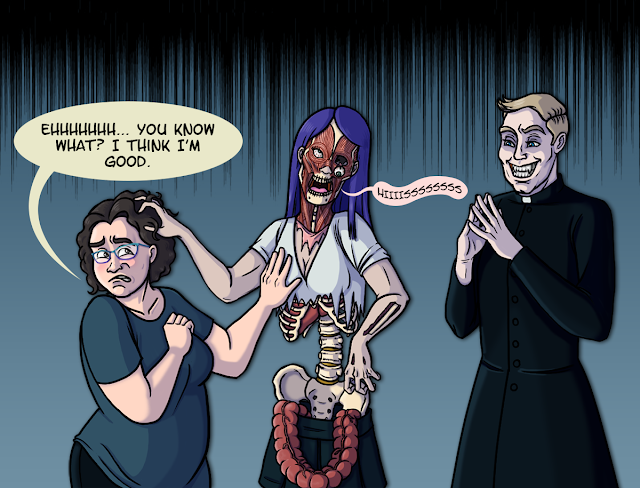
My wife as a mutilated, living corpse is definitely one of the weirder things I've drawn. I showed this drawing to her and now she's shuffling around the house pretending to be a zombie. 
There is one other, much more significant issue I had with the book.
***Content warning for discussion of rape and sexual assault***
Among his many newfound powers, Ricks now possesses the ability to make people sexually attracted to him, whether they want to be or not. This creepy ability is first demonstrated when a heterosexual man finds himself inexplicably lusting after Rick (right before Rick kills and mutilates him). He uses it again on Angela whilst sexually assaulting her, resulting in her arousal during the assault, and the way it's worded is pretty cringe-y:
"Her body began to revolt against every intellectual, spiritual and personal value she had tried painstakingly to uphold. This man, this creature, this demon, had violated her, beaten her, lied to her, threatened her life and the life of her child, but still her body wanted him. It ached for him, as if it would die without his touch, inside and out... She hated each and every betrayal her body made."

This is a trope I absolutely loathe with a burning passion. Let me be perfectly clear: some people do experience an erection, lubrication, or even orgasm during a sexual assault, and there's nothing unusual or shameful about it. It's a purely physiological response and not an indication of enjoyment or a sign of consent. Unfortunately, the belief that any sign of arousal means the victim "wanted it" is still prevalent (and even used as a defense in court cases) and enforced in fiction like Crown of Swords, The Fountainhead, Goldfinger, Game of Thrones, and numerous Harlequin romances. Fifty Shades of Grey actually inspired at least three different cases of sexual assault because these men couldn't understand that fantasizing about being ravished isn't the same thing as wanting to be assaulted (Pro tip: NO ONE wants to be raped). It's not that people shouldn't write about rape (The Round House by Louise Erdrich and Speak by Laurie Halse Anderson both do an excellent job dealing with such a difficult topic) or even erotic fantasies of being overpowered. It's just that with rape culture and world being what it is, authors need to tread very, very carefully when writing about assault. TorApex MagazineWired, the Writing Reddit, and Marie Brennan's blog all do a great job discussing how to write about sexual violence in fiction.

Worship Me isn't nearly as bad as the previous examples I listed, Rick is portrayed as a complete monster whom Angela despises and what he does is reprehensible. I don't think anyone reading that passage is going to think Angela wanted him to assault her, or that it was anything but a violation. But it still could have been handled a lot better and I cringed reading it.
***End of content warning***

Problems aside, Worship Me is still a well-written, and entertaining read. You would think a book where the characters spent the majority of their time trapped within a church reflecting on their personal values would get dull very quickly, but fear not. Action scenes are perfectly placed throughout the story to keep the pace going and the tension high. Even with my ADHD, Worship Me managed to hold my attention throughout the book and I only put it down when I absolutely had to (like when my wife said if I didn't come do the dishes right now she was making me sleep in the backyard). But it's the novel's exploration of faith that makes Worship Me really stand out. I was very fortunate to grow up attending a Congregationalist church part of the United Church of Christ (UCC) with a strong emphasis on humanism, tolerance, science, and social justice, where my sexuality and agnosticism were readily accepted, but many people aren't so lucky. Even churches that aren't showing up on a Southern Poverty Law Center watch list can be intolerant towards anyone they see as breaking some obscure Biblical law from Leviticus. When a religion that's supposed to be about love and compassion is twisted by its followers into an ugly culture of hate, judgement, and hypocrisy it drives people away. But worse than that is when people actually find that kind of message appealing. They're attracted to the "us vs. the sinners" rhetoric and instead of loving their neighbors or respecting differences, they turn to condemnation and cruelty in a misguided attempt to please an angry god and reap the rewards they feel are promised them. And this is the heart of what makes Worship Me so terrifying. Not the monster outside who may or may not be an old god come to challenge the newer god of Abraham, but the horrible lengths people are driven to when they believe without question. Worship Me isn't so much anti-religion as it is anti-zealous, unquestioning belief and fear-based worship. There are benefits to religion, it can offer comfort in dark times and encourage charity and compassion and a sense of community. But when the message is never questioned and when its followers lose the ability to judge right or wrong from themselves, that's when people suffer. Churches will always make me leery. Maybe it's because some very vocal religious types find both my sexuality and my lack of faith sinful, and are not shy about harassing anyone like me. It could also be that whole bursting into flame and vomiting black bile every time I step onto holy ground thing that happens, who knows. What I do know is the Worship Me has definitely made me think twice about visiting a house of God again, lest it hold some even darker secrets.

Wednesday, August 1, 2018

The Mine by Arnab Ray

The Mine by Arnab Ray. Recommended. Read if you like Event Horizon, Sex and Violence.


Formats: Print, digital

Publisher: Westland (Indian publisher now owned by Amazon)

Genre: Blood & Guts (Gorn), Psychological Horror, Occult
Audience: Adult/Mature

Diversity: South Asian/Desi/Indian, Disabled character (uses a wheelchair due to partial paralysis, mute/Aphonia)

Takes Place in: Thar Desert, Rajasthan, India

Content Warnings: Abelism, Bullying, Cannibalism, Child Abuse, Child Death, Child Endangerment, Death, Drug Use/Abuse, Forced Captivity, Illness, Gaslighting, Gore, Kidnapping, Medical Torture/Abuse, Medical Procedures, Mental Illness, Self-Harm, Rape/Sexual Assault, Sexism, Slurs, Slut-Shaming, Stalking, Suicide, Torture, Violence, Xenophobia (Highlight to view)

Blurb:
At a secret mining facility somewhere in the deserts of Rajasthan, an ancient place of worship, with disturbing carvings on its dome, is discovered buried deep inside the earth. Soon the miners find themselves in the grip of terrifying waking nightmares. One tries to mutilate himself. Worse follows.

Five experts are called in to investigate these strange occurrences. Sucked into a nightmare deep underground, they embark on a perilous journey; a journey that will change them forever, bringing them face-to-face with the most shattering truth of them all…

The greatest evil lies deep inside.


Imagine combining Event Horizon with Agatha Christie's And Then There Were None then mixing in the criminally underrated film Below. Set it in a mine deep below the Great Indian Desert and you'll get an idea of what you're in for in Arnab Ray's horrifying, claustrophobic, sex-filled gore-fest of a novel about five adults and one little girl trapped underground with their guilt.
The Mine starts out with Samar, a rich recluse specializing in industrial security, wallowing in his grief after the disappearance of his daughter and the death of his wife. Yeah, Samar has shit luck. A mysterious man named Arnold Paul (whose name I kept reading as Arnold Palmer) finally bribes convinces Samar to drag his depressed butt out of bed by offering him a large sum of money to go with him and do a sketchy job, the details of which Paul/Palmer won't reveal. Samar is apparently used to this sort of thing due to his work as a security expert/spy for secret government ops, and figures he wasn't doing anything important anyway (except moping and sleeping) so he begrudgingly accepts the offer and heads off for the titular mine. As it turns out, greed is a great motivator because Mr. Paul/Palmer has also convinced four other experts to go to the middle of nowhere with a complete stranger, no questions asked.

Joining Samar are Dr. Karan Singh Rathore, a diplomatic and laid back older gentleman who specializes in infectious diseases; Dr. Anjali Menon, a widowed archeologist who brought her disabled daughter, Anya, along; Dr. Akshay More, an arrogant and obnoxious assistant professor in forensic toxicology; and Dr. Preeti Singh, a short-tempered psychologist with a surprising lack of people skills. The group has been brought together to give their expert opinion on a series of deadly accidents that seem to have been caused by the discovery of an ancient, creepy temple the miners are too afraid to go near. A temple that also happens to be covered in explicit carvings of naked women being tortured and killed, because whomever created the damn thing is sexist and gross. If that wasn't ominous enough, the director of the mine is named Lilith Adams. While it's fully possible her parents were just uncreative goths from the early 00's, it's far more likely that Ms. Adams just picked the most obvious evil pseudonym since Alucard and Lou C. Pher.

At this point, most people would've noped the fuck out of there, but Samar and the scientists have clearly never seen a horror movie in their lives and are too wrapped up in their own issues to notice the whole situation has more red flags than a May Day parade in Moscow. The mine could not be more obviously evil if it had "Gateway to Hell" in big florescent lights over the entrance, ominous music playing in the background, and a bunch of demons chilling in the conference room. Then again, these are people who willingly followed a creepy stranger into the middle of nowhere to visit his sketchy underground dungeon (literally, the workers are all criminals and aren't allowed to leave until their contracts are up) because Paul/Palmer promised them candy/money. Little kids have more street smarts than this group, so I shouldn't be surprised they're completely oblivious to danger.

I mean, even I figured out the candy van was a trap after the first 9 or 10 times.
Akshay and Anjali explore the torture-porn temple and discover it depicts ironic punishments attributed to specific sins. Meanwhile, Karan and Preeti talk to the survivors, who share stories that would make Rob Zombie squeamish. Akshay makes light of the situation and acts like a jackass, Anjali does her best to ignore everyone and just do her job, Karan remains calm and reasonable, and Preeti is hostile and short-tempered. Samar checks the security and continues to have no fucks to give beyond a kind of creepy obsession with Anya, who reminds him of his dead daughter. The general consensus among the workers is that they've somehow opened a portal to hell and everyone in the mine is going to die horribly as a result of their dark pasts. Needless to say, company morale isn't great. At this point, everyone finally agrees this place is super creepy and they want to collect their paychecks and GTFO. Alas, in a twist that should come as a surprise to exactly no one, Lilith turns out to be evil, and sets off an explosion that kills all the mine workers and traps the six survivors (Samar, the scientists, and Anjali's daughter) inside while she laughs manically about the mine's real resource being fear. Worst. Job. Ever.
                                                                    Her name is Lilith, what did you guys expect?
The explosions cause the security systems to engage, sealing the group inside with a series of death traps. Because why wouldn't you want death traps in an already dangerous mine? On top of everything, an experimental gas that causes super human strength and insanity is being pumped through the A/C, which frankly, feels like overkill to me, but hey, they can run their portal to hell however they want. After their initial panic, presumably followed by the realization that they really should have seen all of this coming, the survivors formulate a plan to navigate the traps and make it to the surface. They're slightly hindered by the fact they have to trust each other and work together to make it out, and most of them are deceitful, suspicious, assholes, not to mention all the stupid puzzle traps that were apparently inspired by 80s video games. One such puzzle involves trying to obtain acid vials while avoiding motion activated laser and an electrified floor, and if you succeed you'll be rewarded with a chainsaw, which may be useful later. Unfortunately in this "game" their are no save points or extra lives.

What follows is about what you'd expect for a book about trying to escape from a possibly haunted mine with a bunch of jerks, but the predictability doesn't make the story any less suspenseful or gripping. But face it, if you're reading this book, you're looking for creative deaths, not creative storytellin, and boy, does Ray deliver there. Besides, the true mystery doesn't lie in their Aeneas-like journey through the mine, but in each character's backstory, all of which are slowly revealed as they try to escape the subterranean deathtrap. Each of the adults has done something criminal and escaped punishment, and have been struggling with their guilt ever since. The quality of the backstories varies, with some characters (like Akshay and Preeti) getting plenty of focus, while Anjali gets very little characterization beyond "the aloof mom". So too do their sins seem to be of differing severity. Some of the survivors have committed crimes so awful as to make them irredeemable, while others are more sympathetic and their sins, while still terrible, are still at least partly understandable. This disparity seems a little unfair as it means at least some of the group will potentially suffer a gruesome death (at least according to the carvings in the temple) over something that would normally earn them less than 15 years in prison (at least in the US, not sure about the Indian judicial system). It's not that their crimes aren't bad, they just don't seem to merit a sentence of being reduced to a puddle of bloody viscera.

We never really learn if the mine is truly being controlled by a demonic entity or if the group's guilt and paranoia (fueled by the hallucinogenic gas) is causing them to attribute bad luck to malicious forces and see things that aren't there. Samar even suggests that the whole thing is an unethical experiment by the government to test their new gas on subjects no one will miss, as there are far too many coincidences for mere random chance, and the temple may be a fake created to amp up their fear levels. Since none of the characters are able to trust their own senses, making them unreliable narrators, arguments could be made for either scenario, making the story even more spooky and disturbing. Monsters are scary, but they're even scarier when you can't even tell if they're real or simply the imaginary scapegoats of guilt-ridden, paranoid people. Even more frightening, Ray argues, are the depths of human cruelty and depravity, which are explored in each character's backstory. Though that may just be an excuse to squeeze more gore out of the story.

The Mine does an excellent job balancing itself between psychological horror and splatterpunk. The true scares lie in the book's creepy atmosphere, suspense, and the characters slowly succumbing to madness; the over-the-top gore is simply dessert. Unfortunately, this otherwise perfect blend of horror comes with as huge helping of misogyny. Yuck. Look, I'm fully willing to admit I'm part of the lowest common denominator who just wants to see heads exploding like overripe cherries and attractive people boning, but that doesn't mean I like sexism. Unfortunately, more often than not, the three seem to go hand in hand, much to the frustration of female horror fans, and other, more enlightened individuals who just happen to like hot sex and lots of blood. Ray isn't as bad some other authors out there, the violence is pretty evenly split between the genders and there aren't any scenes of knife-wielding killers chasing half naked women. He even manages to handle the subject of sexual assault fairly well, choosing to focus more on the problematic culture of victim-blaming and men who feel entitled to women's bodies rather than the rape itself. But he struggles with creating believable female characters, defining them by their relationships with men, and them victimizing them. Both of the female scientists have backstories that involve abuse and mistreatment at the hands of men, and instead of being written as strong, survivors, they both come off as bitter, man-haters. Apparently Ray subscribes to the theory that in order to be "strong" a woman must act rude, aloof, aggressive, and despise an entire gender, with the exception of that one special man who tames her with his magical penis. Which is why both Anjali and Pretti act like complete jerks, with Pretti especially flying off the handle at every perceived slight (she must be a great psychologist), and basically being awful to everyone except, ironically, Akshay whom she latches onto almost immediately (despite the fact that he's literally just the worst). Despite all her bluster, Pretti still falls quickly into the role of helpless victim in need of a man's protection at the first sign of danger. It's really embarrassing. I guess she can't help it because she's an emotional female with a hysterical uterus or some such nonsense. The women in the story are all described as being gorgeous, but only one male character is described as being very attractive, the wholly unlikable Akshay, and that's only because his appearance is supposed to reinforce how vain and materialistic he is. Many of the women are also incredibly horny, even minor characters, like Tanya the gold-digging nurse, and Ray paradoxically has no problem slut-shaming them for it (apparently enjoying sex is sinful enough to get you murdered by the mine), even though he later demonizes other characters for doing the same thing. Maybe the mine is just super slut shame-y. The unearthed temple certainly implies that someone behind the scenes hates women.

The women in the story seem less like real people and more like a weird combination of straw-feminists and male masturbatory material, with Ray putting way too much emphasis on their appearance, sex drives, and relationships with men. Then of course we have Anya, who, while thankfully not a sex object, is still treated as an object nonetheless. She barely gets any characterization, and doesn't communicate even through sign language or writing, she's just a blank slate for Samar to project his weird daughter obsession onto. It's doubly problematic since Samar seems to use Anya's disability as an excuse to treat her like a life-sized doll he can love, protect, and turn into his replacement daughter. Because she's mute he assumes she has nothing to say, and because she doesn't walk he thinks she's completely helpless. We don't even get to learn what she's thinking, or how she feels about Samar treating her as some sort of second chance, because, unlike the other characters who all get their turn in the spotlight of the limited, third-person narrative, Anya is completely ignored. At least she gets a little bit of a role later on (which I won't spoil). Miraculously, Lilith Adams is the only female character who is neither a victim, nor a sex fantasy, and is described only as being terrifying, intense, and very much in charge, much like her namesake.

This definitely feels like a stranger danger situation.
So the female characters are about as well written as you'd expect from a male author who doesn't know how women work, and the whole "helpless, sick wheelchair girl" trope is super problematic. It's not the worst treatment of women I've seen in splatterpunk, but I'd still prefer to enjoy my blood and guts without the side of sexism. I mean, I don't think it's an unreasonable request. The writing is still pretty good, and it's definitely the scariest book I've read so far this year. The Mine is also one of only a few Indian horror novels I've been able to find in English. Whether that's enough to overshadow the book's problem areas, however, is up to the individual reader. 

Thursday, May 3, 2018

F4 by Larissa Glasser


Writing – 2, Horror – 3, Diversity – 4


Formats: Print, Digital

Publisher: Eraser Head Press

Genre: Blood & Guts, Body Horror, Monster, Sci-Fi Horror

Audience: Adult/Mature

Diversity: Trans women, Bisexual women, Queer women

Takes Place in: North Atlantic Ocean

Content Warnings: Bullying, Drug Use/Abuse, Death,  Forced Captivity, Gore, Homophobia, Kidnapping, Mention of Medical Procedures, Police Harassment, Rape/Sexual Assault, Sexism, Slurs, Stalking, Suicide, Transphobia, Verbal/Emotional Abuse, Violence  (Highlight to view)


Blurb:


A cruise ship on the back of a sleeping kaiju. A transgender bartender trying to come terms with who she is. A rift in dimensions known as The Sway. A cruel captain. A storm of turmoil, insanity and magic is coming together and taking the ship deep into the unknown. What will Carol the bartender learn in this maddening non-place that changes bodies and minds alike into bizarre terrors? What is the sleeping monster who holds up the ship trying to tell her? What do Carol’s fractured sense of self and a community of internet trolls have to do with the sudden pull of The Sway?

Please note: This review was written before I was out as genderqueer. In the review I refer to myself as not being part of the trans/non-binary community. This inaccurate. 

The horror genre is not generally kind to trans-women, frequently depicting them as serial killers and/or sexual deviants. Hell, fiction in general doesn't treat trans people well, forcing them into a victim role and focusing on their angst and dysphoria. So you can imagine how unbelievably excited I was when I learned that Eraserhead Press was publishing a horror story about a bad ass trans woman who fights monsters and alt-right trolls. Even better, it was being written by a trans woman! Glasser is  a librarian from Boston which makes her five-hundred times cooler in my eyes (I love librarians, they're like keepers of secret knowledge and they know everything). The reviews for F4 have so far been unanimously positive, the premise sounded weird and awesome, and it promised representation rarely found in the horror genre. F4 was like everything I had wished for and I could not pre-order it fast enough.

Well, apparently whatever jinni decided to grant my wish for an awesome trans-lady horror story written by a trans person was one of those dick bag jinn who likes to pull that Monkey's Paw shit, because I haven't been this disappointed since I first saw Star Wars Episode One after months of hype.


I’m clutching handfuls of blue bills and angrily screaming at the Djinn from the Wishmaster film series who is looking please with himself. I yell “Why the FUCK would I wish for $100,000 in Zimbabwe dollars you unbelievable asshole!?!”
I guess I'm just lucky the Djinn didn't give me $10,000 in pennies that fell from the sky and crushed me to death.
Carol, the main character of the story, is a trans-woman who works as a bartender on the Finasteride, a cruise ship built on the back of the F4. This name does not, in fact, come from one of those computer function keys that no one ever uses for anything (except maybe the F5 key), but instead refers to the last of four kaiju that mysteriously appeared on earth and fucked up a bunch of stuff. Okay, so far so good. Then, all of a sudden, everyone on board starts turning into eldritch abominations... and thus begins a confusing clusterfuck of unexplained randomness. The transformations may or may not have something to do with a dimensional rift called the Sway, which isn't mentioned prior to everything going to hell, is never fully explained, and may or may not be common knowledge in the book's world.  Carol's creepy boss and his even creepier buddy are behind everything, because they want to sail into the Sway, but their motivation is never explained beyond some vague lust for power. Well, if it works for Saturday morning cartoon villains I guess it's fine. There's also a wizard who lives in the Sway and can control the Kaiju, who we've also never heard of before and who also isn't really explained. Again, it's really unclear whether this is common knowledge or not, or if the Sway is actually just some giant, extra-dimensional plot hole and we're just expected to go with it. The weirdest part is that even though the wizard controls the kaiju, he isn't evil despite his giant beasts killing millions of people. One of them even destroyed New York City looking for Carol (why though!?!), but fuck all those victims, I guess? Why is no one horrified by all this? Oh, and apparently Carol's penis is some sort of magical flesh key or something, I don't even know. Maybe her penis' magic is why she gets erections constantly (and won't shut up about it), despite having had an orchidectomy. Usually, having your testicles removed or going on testosterone blockers causes penis-having folk to have very few spontaneous erections (and some stop getting erections all together) so it seems really odd that Carol keeps getting constant danger boners (which would be an awesome band name) but I'm hardly an expert, so whatever.

In addition to her bartending duties, Carol also makes sex videos on the side with her friend Chole, another transwoman whom she's slightly obsessed with. Carol's wait staff of trans women, or "lady dicks" as she calls them, also make extra cash "servicing" the passengers of the Finasteride. This is the part that made me feel really weird. Frequently when trans people appear in fiction, it's as some sort of sex worker, and they're being written by cis folk who have little understanding of, or respect for both trans women or sex workers. It's such a cliché that cops will actually harass trans women on the street because they assume they're prostitutes. So having the majority of the trans women in a story do some sort of sex work felt problematic, especially since most of the clients appeared to consider them a fetish rather than real people. It certainly doesn't help that Carol doesn't even seem to like doing web-cam work, and is only tolerating it because Chole pressured her into making porn. I enjoy naked people having sexy fun times as much as the next person, especially when those people are queer and/or non-binary, and one of the things that originally drew me to F4 was the promise of erotica with trans-ladies. But when the participants are being pressured, exploited, or fetishized, porn is just gross. F4 felt more like the later. The sex scenes aren't even arousing. One involves a toothless dude drooling in Carol's ass crack as she feels uncomfortable and wishes it were over. Ick. Chole also gets sexually assaulted by one of the kaiju's parasites in a really uncomfortable scene (which I think was supposed to be humorous?) and Carol does exactly jack and shit to help her friend. Maybe weird, unappealing sex is a staple of bizarro fiction, but trans women are disrespected enough in the porn industry, I was really hoping it wouldn't happen here too.

The comic is titled “Trying to find trans porn.” The first panel says, “what I expected” and depicts me blushing and looking aroused while I imagine two women of color, one of whom is plus-sized, in an intimate situation looking lovingly at each color. The second panels says, “What I got” and shows me recoiling in horror and disgust from my laptop. A toxic green speech bubble reveals what is written on the screen, and is full of transphobic language like “Tr***y Sex”, “Trap Hentai”, and “Lady boys”.

F4 isn't like the terrible, transphobic porn you might find online, but it's not particularly good erotica either
My confusion regarding the story line made it difficult to focus on the book (as did the frequent mention of dicks), and I probably would've given up on it completely if not for part two, the saving grace of F4. Part two is proof that Glasser really is a talented author. Instead of getting a bunch of random nonsense throw at us we get an intriguing and suspenseful, but straight forward story of Carol's life prior to the Finasteride. Her character suddenly feels relatable. She's dating a loser she can't seem to dump, living in the middle of nowhere, and trying to figure out what to do with her life. Carol witnesses a murder, and tries to do the right thing by reporting it to the cops. But since no good deed goes unpunished, she finds herself in the media spot light after becoming a key witness in the murder case, and becomes a victim of an online hate campaign by a bunch of transphobic trolls. Part 2 is great! It's intriguing, suspenseful, we finally get some explanations about what's going on, and of course Glasser had to go and ruin it by making part 3 even more random and confusing. This just made me hate the rest of the book even more because I now knew I could've been enjoying a well-written story about a trans woman vs. a bunch of internet trolls, and dealing with the dilemma of being punished for doing the right thing. But instead I had to put up with awkward sex, magical girl dicks, and a series of loosely connected plot holes. So I became bitter and sulkily rushed through the third part of the story, desperate to find some of the magic from Part 2. The only thing that redeemed part 3 was Carol killing the two entitled dudebros who fucked everyone over for more power, one of whom was the leader of the internet trolls who ruined her life. That was immensely satisfying.

So yeah, I really didn't like this book. Of course, I'm not trans (well, I am, but I wasn't out when I first wrote this), so it's possible my privilege was preventing me from recognizing the appeal of F4. All the reviews I had read online were overwhelming positive, so what was I missing? Was it just not intended for me? So I went to my friend, Ashley Rogers (who you may remember from the Oddity post), for help. I figured since she's an author herself, a trans sensitivity reader, and a trans rights activist she'd be able to offer some valuable insight. Although Ashley is currently busy working on SCOWL: Fight for your Rights, a subversive, queer-focused, stage combat piece (I designed the logo so I have to shamelessly pimp the project), she was kind enough to take some time out of her busy schedule to share her opinion with me. I also asked her to explain what Glasser meant when she kept talking about "hatching eggs", but Ashley didn't know either, nor did any of the other trans and non-binary people I asked, and I eventually had to resort to Reddit and Urban Dictionary.


I’m climbing through the window of my friend, Ashley Roger’s, apartment (presumably having broken in). “Ashley help! What does it mean for a trans person to “hatch”? Are magical dicks empowering or weird? What about trans porn?” I ask. Ashley, a tall woman with a fashionable blue top, blond-streaked, shoulder length hair, and expertly done make-up, is sitting on the couch and leaning away from me, looking annoyed. “How do you keep getting in here?” she demands.
It turns out "eggs" refer to closeted trans folk still struggling with their identity who have not yet come into their own.
Ashley had the following to say:

First a disclaimer: Trans/n-b folk can and should be able to tell whatever stories we want.  I love bizarre and spooky material, and I want trans folk to succeed, and regardless of my feelings on this novel I am excited to see more from Larissa Glasser...
Buuuuuuuut...

My main criticism is that the piece doesn't seem to know what it wants or who it's written for. F4 intends to shock (evidenced by the material referenced in the piece such as Cannibal Holocaust and The Human Centipede) but it falls short of living up to those expectations.  We don't live in the uncomfortable moments and grotesque situations long enough to care.  At most we're left with a sense of "ok... That's fucked up," but then we move on to something else before we have a chance to feel unsettled.


Part two feels like a completely different (and subjectively better) novel entirely.  I was gripped by the backstory and it had a great flow, and some of the concepts are really cool (Hell, it's about turning a Kaiju into a cruise liner!!), but as a trans woman I couldn't help but be bored by how often Carol popped a boner in the face of danger.  One of the positive critiques I've seen from other trans women is that it's a story that isn't about a trans character who's sad, angry, and depressed about surgical transition/dysphoria but the way the author focuses on Carol's anatomy and overly sexual descriptions rather than creating the atmosphere distracts from the story and intriguingly bizarre concept of the piece in the same way these other pieces focus on the tragedy porn that gets written about our physical transition struggles.  If this book was all part two I would be writing a very different statement but... I wish it were either more shocking in execution or more approachable in material, but as it stands it sits in limbo of both.

I won't lie, I feel genuinely guilty about not liking F4. I mean, everyone else loves it, and I want to be supportive of trans and non-binary folk in a cis-centric genre, but I just could not enjoy the story. I had no idea what was going on half the time, a lot of it just seemed to be weird for the sake of weirdness and contributed nothing to the story, and, the sex scenes felt more gross and exploitative than sexy and empowering. I liked the ideas behind F4, but the execution left a lot to be desired. Glasser clearly has talent as a writer, as is evident from part 2 of the story, so maybe I just don't like bizzaro horror, I don't know.  At the very least I can say it's like nothing I've ever read before. In the mean time, I'm going to stick to reading Nerve Endings when I'm in the mood for some well written trans erotica.